
Ubud · Viewpoint
Tegallalang Rice Terrace: Visitor Guide
Ubud's most photographed paddies at Ceking, and how to see them before the crowds
By the Baligasm editors · Updated 29 October 2026 · Photo by @whereisnikita
Overview
Tegallalang Rice Terrace: before you go
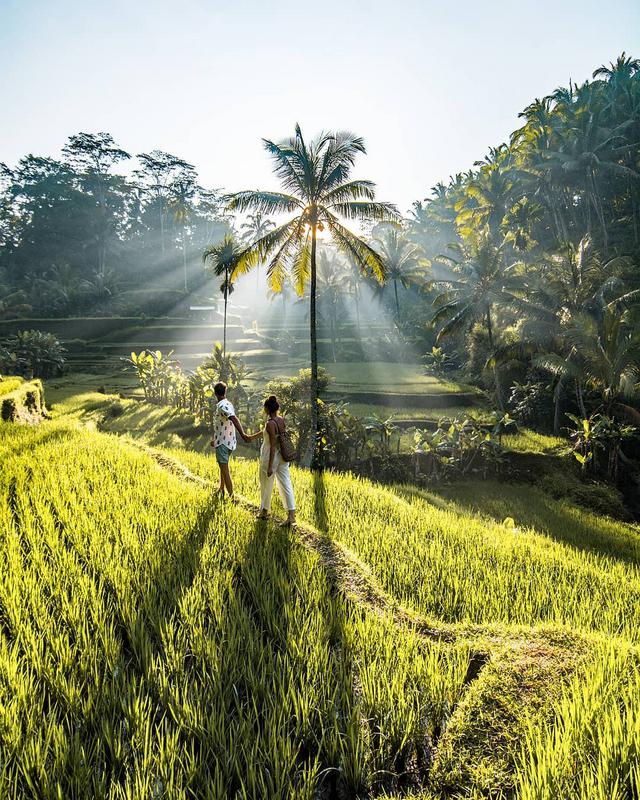
Tegallalang Rice Terrace is a steep, palm-lined valley of paddies at Ceking, 10 km north of central Ubud and roughly 1.5 to 2.5 hours by road from the airport. No rice field in Bali appears in more photos. Come around 7 am and walk down among the plots, and it is lovely; come at noon and it is a queue. Couples, photographers and first-timers enjoy it most. Plan on one to two hours.
Ceking lies on the Kintamani road out of Ubud, inside the Gianyar district of Tegallalang. The highway runs along one edge of a narrow river valley, the west side, and the famous paddies drop down the opposite slope under coconut palms. Nobody manages them as a park; they are farmland. The east bank is owned by fewer than ten families from Banjar Tangkub and Banjar Kebon, in Kedisan village, and the swing parks, shops and cafés occupy the road side. Who owns which bank explains most of what you will meet, including the number of times someone asks for money.
Balinese paddies depend on subak, the cooperatives that divide spring and weir water between farmers using canals and little temples. The system goes back roughly to the 9th century. When UNESCO inscribed the Cultural Landscape of Bali Province in 2012, it chose five places: the Catur Angga Batukaru terraces (home to Jatiluwih), the Pakerisan valley by Tampaksiring, Lake Batur, Pura Ulun Danu Batur and Pura Taman Ayun. Ceking was left out. Its owners have never formed a registered subak and simply use the water that trickles down from plots higher up.
In March 2012 Gianyar handed control to Tegallalang's customary village, whose management body keeps the parking and gate takings. A year later those takings topped IDR 100 million monthly, against IDR 500,000 a month paid to one farmer for maintenance. The owners stopped receiving anything by 2020. In protest some aimed mirrors at the cafés to glare at customers, and the bridge joining the two banks was severed. That quarrel is why you now find farmer donation boxes, paid private paths and café entry charges.
Arrival time matters more than anything else here. At seven in the morning you share the slope with farmers, a handful of photographers and gentle light through the palms. Around midday the rim turns into a row of swings, cafés and booths, the steps are hot, and most viewpoints have a queue. Travellers who simply want calm rice fields, rather than this exact view, will be happier at Jatiluwih or Sidemen, or on Ubud's own Penestanan and Juwuk Manis walks.
- Opening hours
- No gate; booths and cafés operate roughly 8 am–6 pm
- Ticket
- No set ticket; each entry booth asks around IDR 15,000–20,000
- Time needed
- One to two hours, walk down and back included
- Best time
- Early, 6–8:30 am, ahead of the tour coaches
- Dress code
- No dress code; grippy shoes rather than flip-flops
- Location
- Ceking, Tegallalang, 10 km north of central Ubud (20–30 min)
Tegallalang Main Road, Ceking, Tegallalang, Gianyar, Bali 80561
Open in Google Maps ↗Read it on the Blog →What to see
What to see at Tegallalang Rice Terrace
The rim view at Ceking
Seeing the classic panorama is free. Lean on the low roadside walls, or order a drink at a west-side café, and the terraces fill the hillside across from you beneath their coconut palms. Morning sun filters softly through the trees, and from about 3:30 pm the light turns good again. By ten o'clock parked cars crowd the verge and the front tables have all been claimed.
The walk into the valley
From the road, paths and stairways descend to a stream at the valley floor before rising again through the paddies on the far side. Budget 30 to 60 minutes for the circuit, or longer with photo stops. The steps are irregular and turn greasy after rain, and hauling yourself back up in the midday heat is the tough bit. The connecting bridge was cut in 2020, so getting onto the east bank now usually involves a swing park or a privately run path with its own charge.
Paying your way
Forget the idea of one ticket. The booths at each entrance want around IDR 15,000–20,000 per head. On the east side, farmers stationed at path crossings ask IDR 10,000–20,000, and going in through a swing park or café may mean IDR 50,000 or a minimum order. Keep plenty of small notes. Donations given to the farmers go to the people who keep the plots planted, and they have long complained that little of the gate income reaches them.
Swings, nests and zip lines
Along the rim, operators like Uma Ceking, plus bigger outfits further up the road such as Alas Harum, sell swing rides above the valley, nest-shaped photo platforms and flying foxes. Expect to pay IDR 250,000–400,000 for a package (mid-2026 rates), and extra if you hire one of the long flowing dresses. No specific safety rules govern these businesses and enforcement is uneven, so inspect the harness, the backup line and the crew before you strap in.
The rice cycle
A plot passes through several looks: flooded and mirror-like, then bright green shoots, then golden grain, harvest and finally brown stubble. Since every owner sets their own planting dates, adjacent terraces often show different stages, and no calendar month promises green. Modern rice can give three harvests a year, while some Ceking families still grow a local variety needing around six months. Photos uploaded by visitors over the past few days tell you what to expect.
The first hour of the day
From roughly 6 to 8:30 am it is cool, farmers are working, and the booths are often empty. Coaches begin pulling in at about nine. Most cafés and swing parks only open between eight and nine, so going early means giving up coffee and swings in exchange for quiet paths and the gentlest light.
Seasons
Best time to visit Tegallalang Rice Terrace
The ideal window is 6 to 8:30 am, when the paths are cool, the farmers are out and the light is soft. Coaches arrive from around nine, and from late morning until mid-afternoon the rim, the swings and the paths are packed. If you cannot do mornings, the late-afternoon slot from roughly 3:30 to 5:30 pm brings warm light and thinner crowds.
Walking is easiest between April and October, when the ground is firm and showers seldom interrupt you. Ubud gets about 2,240 mm of rain annually; January is the wettest month with around 325 mm, August the driest with around 90 mm. In the November to March rains, go first thing, before the afternoon storms, and avoid the steepest paths after a downpour.
Green fields are a matter of crop timing rather than season, since owners plant whenever suits them. Crowds peak in July and August and over the Christmas holidays.
Getting there
How to get to Tegallalang Rice Terrace
Ubud centre20–30 min
Head 10 km north towards Kintamani by scooter or car. An app ride will get you there, but sort out the return trip before you walk down.
Kintamani (Penelokan)35–50 min
Straight downhill on the same highway, which makes it a natural stop after the Mount Batur sunrise hike.
Sanur1–1.5 hours
Drive north via Ubud. Of all the coastal bases, Sanur makes the early start easiest.
Kuta or Seminyak1.5–2.5 hours
Hire a driver and fold it into a wider Ubud day out. Set off around 5:30 am to beat the coaches.
Canggu1.5–2.5 hours
Cross Denpasar by car or scooter; how long it takes depends on morning traffic. Pairing it with Tirta Empul justifies the journey.
Ngurah Rai airport (DPS)1.5–2.5 hours
A car or pre-arranged transfer runs via Denpasar and Ubud. Few people come straight from the plane; most base themselves in Ubud first or join a day tour.
| From | Time | How |
|---|---|---|
| Ubud centre | 20–30 min | Head 10 km north towards Kintamani by scooter or car. An app ride will get you there, but sort out the return trip before you walk down. |
| Kintamani (Penelokan) | 35–50 min | Straight downhill on the same highway, which makes it a natural stop after the Mount Batur sunrise hike. |
| Sanur | 1–1.5 hours | Drive north via Ubud. Of all the coastal bases, Sanur makes the early start easiest. |
| Kuta or Seminyak | 1.5–2.5 hours | Hire a driver and fold it into a wider Ubud day out. Set off around 5:30 am to beat the coaches. |
| Canggu | 1.5–2.5 hours | Cross Denpasar by car or scooter; how long it takes depends on morning traffic. Pairing it with Tirta Empul justifies the journey. |
| Ngurah Rai airport (DPS) | 1.5–2.5 hours | A car or pre-arranged transfer runs via Denpasar and Ubud. Few people come straight from the plane; most base themselves in Ubud first or join a day tour. |
Know before you go
Tips for your visit
- 01Arrive by seven. No other decision changes the experience as much.
- 02Small notes are essential: booths, donations and parking nearly all want cash.
- 03Roadside parking is around IDR 5,000 per scooter and IDR 10,000 per car. Lots are full by late morning, at which point drivers let you out at the rim and wait further along.
- 04Hiring a driver is the easy option. Local transport groups sometimes block app pickups here, so pre-book the ride home or ask your driver to wait.
- 05Grippy sandals or trainers beat flip-flops on the steep, muddy steps.
- 06Take water and a hat: there is little shade below the road and the climb out is hot.
- 07Where farmers wait at crossings, IDR 10,000–20,000 per person is the normal contribution.
- 08Before paying for a swing, confirm the price, what is included and how many photos you get; do not ride in the rain.
- 09Keep to single file, step aside for farmers with heavy loads, and never walk on planted plots or in the irrigation channels.
- 10Get permission before sending a drone over anyone working the fields.
- 11Tirta Empul and Gunung Kawi are 15 to 30 minutes away and make a full morning with the terraces.
FAQ
Tegallalang Rice Terrace questions, answered
Is a trip to Tegallalang worthwhile?
+
Yes, provided you arrive early. At around seven the paths are empty, the light is gentle and you can wander down through the plots without waiting. Later in the morning the rim fills with swing parks, cafés and donation stops and the mood becomes commercial. Anyone after quieter paddies should look at Sidemen in Karangasem, Jatiluwih in Tabanan or, without leaving town, the Juwuk Manis walk.
What does it cost to get into Tegallalang?
+
You will not find one official ticket. Expect each entrance booth to charge around IDR 15,000–20,000 per head, farmers on the east bank to request IDR 10,000–20,000 at certain crossings, and swing parks or cafés to charge IDR 50,000 or set a minimum spend if you enter through them. Parking is another IDR 5,000 for scooters or IDR 10,000 for cars. Carry cash in small denominations.
When does Tegallalang open and close?
+
With no gate, the rim is accessible around the clock. The booths tend to be staffed, and the cafés open, from about 8 am until 6 pm, while swing parks get going between eight and nine. Turn up at dawn and you will often find nobody collecting money and the paths almost empty.
What hour should I aim for?
+
Somewhere between 6 and 8:30 am, so you are ahead of the coaches that start arriving around nine. It is cooler then, the light is kinder and farmers are working the plots. Late afternoon, roughly 3:30 to 5:30 pm, comes second. Walking conditions are better in the April to October dry season than during the rains.
Which months are the terraces green?
+
There is no fixed green season, because the colour follows the crop. Every owner plants on their own schedule, so on any given day some plots are lush, some flooded and others just harvested. That explains why different sources name different green months. The reliable approach is to look at visitor photos uploaded in the last few days before you go.
Are the Tegallalang swings safe, and what do they cost?
+
Packages ran at about IDR 250,000–400,000 in mid-2026, plus a fee if you rent a dress. Standards vary from one operator to the next, since no specific rules apply to these businesses and enforcement is patchy. Check for a full harness and a separate safety line, agree exactly what you are paying for, and skip the ride if it is raining.
How much time should I allow?
+
Most people spend one to two hours. A coffee and the view from the road take about twenty minutes. Walking down to the stream and up the opposite side adds 30 to 60 minutes, and a swing session on a busy day, once you count the queue and the photos, can add an hour more.
Does UNESCO list Tegallalang?
+
It does not. UNESCO's 2012 Cultural Landscape of Bali Province is made up of five places: the Catur Angga Batukaru terraces with Jatiluwih, the Pakerisan valley by Tampaksiring, Lake Batur, Pura Ulun Danu Batur and Pura Taman Ayun. Tegallalang sits outside every one of them, even though its terraces are farmed in the same way.
What is the easiest way there from Ubud?
+
It is a 10 km run north on the Kintamani road, about 20 to 30 minutes by car or scooter. Using a hired driver saves hassle, since local transport groups may stop app drivers collecting passengers at the terraces. If an app ride drops you off, arrange the journey back before starting down the steps.
Should I choose Jatiluwih or Tegallalang?
+
Given a whole day, pick Jatiluwih. It is part of the UNESCO site, its terraces stretch much further and it is far less crowded, though it lies some 56 km, about two hours, from Tegallalang. Tegallalang's advantage is proximity: 20 to 30 minutes from Ubud, it slots into a single morning alongside Tirta Empul.
Nearby
Pair it with
Tirta Empul
15–20 min by car. A spring-fed temple whose pools draw Balinese families for ritual bathing.
Pura Gunung Kawi Sebatu
About 10 min by car. A quieter, smaller spring temple where people come for melukat purification.
Goa Gajah
25–30 min by car. The Elephant Cave, carved in the 11th century, with its ancient pools; handy on the drive south.
Campuhan Ridge Walk
25–35 min by car. A free ridge-top trail between two river valleys, at its best around sunrise.
Kintamani and Mount Batur
35–50 min by car. Crater-rim views across Lake Batur and the island's most popular sunrise climb.
More in Ubud