
Ubud · Temple
Gunung Kawi, Tampaksiring
Royal memorials hewn from a river gorge, reached on foot past rice terraces.
By the Baligasm editors · Updated 29 October 2026 · Photo: Anandajoti / Wikimedia Commons (CC BY-SA 4.0)
Overview
Gunung Kawi Tampaksiring: before you go
Ten 11th-century memorial shrines, carved directly from the rock walls of the Pakerisan gorge, make Gunung Kawi one of Bali's oldest monuments. The site is in Tampaksiring, 18 km north-east of Ubud by road (30–40 minutes) and around 52 km from the airport, with Tirta Empul only 1.5 km away. Entry is IDR 75,000 for adults, sarong included. Budget 1–1.5 hours and good knees: roughly 300 steps lead down, and back up again.
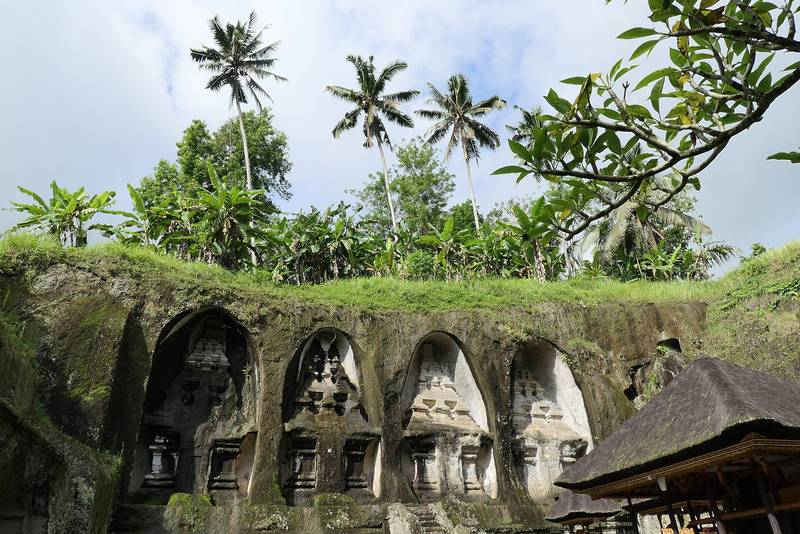
Balinese shrines are normally stacked from brick and stone. Here, 11th-century craftsmen took the opposite route and hollowed them out of the gorge itself. Each of the ten candi is a temple front about 7 metres tall, set into its own recess on either side of the Pakerisan. The Udayana, or Warmadewa, dynasty ruled Bali at the time. Of the three sons of King Udayana and Queen Mahendradatta, Airlangga took the throne of East Java, while Marakata and then Anak Wungsu reigned over Bali. Carving is believed to have started in Marakata's time and been completed by Anak Wungsu, whose rule lasted until around 1080.
You will often hear the shrines called royal tombs. Memorials is closer: places where kings were venerated after death as deified ancestors. An inscription in Kediri script on the east bank's northern shrine reads haji lumah ing jalu, generally taken to mean the king enshrined at Jalu, and its neighbour says rwa nakira, his two children. Who exactly each candi honours is still debated. A popular local tale skips the scholarship entirely and credits the giant Kebo Iwa with carving the whole complex overnight.
H.T. Damsté, a Dutch researcher, recorded the site in 1920. Since 2012 it has fallen inside the Pakerisan watershed component of Bali's UNESCO World Heritage listing, which protects the island's subak irrigation landscape. It has never stopped being a temple. Offerings still arrive, the valley's water serves in ceremonies, and visitors are handed a sarong and sash with their ticket. The route is simple: a long stairway past warungs and terraced paddies, the west-bank group, a footbridge, the east-bank group and a working temple, then a riverside path that loops back through the fields.
Three things to know before going. First, the climb out is steep, and from late morning it is hot, with no drinks sold at river level. Second, the price went up: IDR 50,000 for foreign adults in early 2025, IDR 75,000 on the regency's current ticket portal. Third, there is a namesake. Pura Gunung Kawi Sebatu, roughly 4.5 km to the north-west, is a level spring temple with bathing pools and no cliff carvings, so be precise with your driver. Crowds here are a fraction of those at Tirta Empul, and visiting both makes the strongest temple morning near Ubud.
- Opening hours
- 8 am to 6 pm daily (approximately)
- Ticket
- Adults IDR 75,000; ages 5–11 IDR 50,000; under 5 free; sarong and sash included
- Time needed
- 60–90 minutes, stairs included
- Best time
- Early (before 10 am) or late (after 4 pm), ideally April–October
- Dress code
- Sarong and sash compulsory and supplied; cover shoulders and knees
- Location
- Pakerisan valley, Tampaksiring; a 30–40 minute drive north-east of Ubud
Banjar Penaka, Tampaksiring, Gianyar Regency, Bali 80552
Open in Google Maps ↗Read it on the Blog →What to see
What to see at Gunung Kawi Tampaksiring
Down through the paddies
Tickets are sold at a booth beside the car park, and the sarong and sash are handed over there too. The descent follows a stone staircase of about 300 steps, part-railed, flanked first by warungs and souvenir stands and then by terraced rice. Walkers who do not stop reach the river in around 7 minutes; with photos, count on 15. Morning is the time for terrace pictures, while the sun is still low over the gorge.
The west-bank group
The first shrines you meet are on your own side of the river: four candi facing east, chiselled into the soft padas stone of the cliff. They are facades only, with nothing to walk into, each framed by a niche about 7 metres high. Beneath every shrine, a small chamber is said to contain a stone slab with nine holes. A bathing pool and a water spout complete this bank.
The east-bank group
A little stone bridge carries you over the Pakerisan to the principal row of five candi, which look west. Haji lumah ing jalu is inscribed on the northernmost and rwa nakira on the next. Opinion splits on whom they commemorate: Udayana, Mahendradatta and their sons in one reading, Anak Wungsu with his queens in another. Look up at the roofs, each topped with nine stylised lingam-yoni forms.
Amarawati, the monks' cells
Many visitors walk straight past the cliff rooms. An inscription dated 1023 mentions a hermitage on the Pakerisan named Amarawati, and these chambers are thought to be it. The largest is a cave fitted with a long stone altar; smaller rooms, with little window holes, give onto a carved courtyard. Priests and monks probably sat in meditation here. Some archaeologists read Buddhist practice into the design, evidence that the two religions overlapped in 11th-century Bali.
The tenth candi
Count the shrines and you will reach nine. The tenth sits on its own further south, at a hermitage known as Geria Pedanda. Its brief inscription, rakryan, is a title for a senior court official, so it probably commemorated a chief minister rather than royalty. The path is not obvious, so ask someone where the staircase ends, and save some energy, because it adds a fair bit of walking.
The working temple
Next to the east-bank row is an ordinary active temple, with shrines and open pavilions where villagers often sit preparing offerings. Water from the gorge is still carried to ceremonies. Downstream, the Pakerisan joins the Bulan river; Hindus bathe at such confluences, called campuhan, to purify themselves. Unless you are there to pray, keep to the outer areas and give way to anyone bearing offerings.
Riverside path and rice loop
After the east-bank shrines a trail heads into the trees, keeping the river to your left, and ends in a short circuit of about five minutes through a terraced field. Few people come this far. It shows the relationship between temple, water and paddy that the UNESCO listing was created to protect. Swings and a zipline have been added along the way, at extra cost.
Seasons
Best time to visit Gunung Kawi Tampaksiring
Timing is mostly about heat. The gorge gets direct sun, so the noon ascent is the toughest part of the day; aim to arrive before 10 am or after 4 pm. Crowding is mild even in peak season: in 2022 the site recorded 150–200 foreign visitors daily in July and as many as 400 in early August. If you are pairing temples, be at Tirta Empul for its 8 am opening and move on here for roughly 9:30.
April to October, the dry months, suit both the staircase and the river trail. Between November and March, storms tend to roll over the Tampaksiring hills in the afternoon and leave the stone wet and slick, so go in the morning and choose footwear with grip.
Festival days bring more worshippers. The temple's piodalan, or anniversary, is held near the Katiga full moon, in the third Balinese month, when the shrines are decorated; ask your hotel or driver for this year's date. Galungan falls on 13 January 2027 and Kuningan ten days later. Nyepi, on 8 March 2027, shuts the island completely, with no travel at all.
Getting there
How to get to Gunung Kawi Tampaksiring
Ubud centre30–40 minutes
18 km by road. Two routes work: north via Tegallalang, or south-east via Bedulu and Pejeng onto the Tampaksiring road. A day driver is the usual choice.
Tirta Empul5 minutes by car
1.5 km down the main Tampaksiring road. On foot it is around 20 minutes, but traffic is heavy and there is little room to walk.
Ngurah Rai Airport1.5–2.5 hours
52 km via Denpasar and Gianyar; the Denpasar stretch decides how long it takes. Book a driver ahead.
Canggu or Seminyak1.5–2.5 hours
46–47 km. Set off around 7 am to do both Tampaksiring temples before the heat, and break the return at Tegallalang.
Sanur1–1.5 hours
38 km heading north through the Gianyar regency.
Nusa Dua or Uluwatu2–3 hours
59–68 km. Not a half-day outing; stay a night or two in Ubud and go from there.
Penelokan, Kintamani30–40 minutes
18 km downhill from the caldera rim. Works after a Mount Batur sunrise climb, provided your legs still have 300 steps in them.
| From | Time | How |
|---|---|---|
| Ubud centre | 30–40 minutes | 18 km by road. Two routes work: north via Tegallalang, or south-east via Bedulu and Pejeng onto the Tampaksiring road. A day driver is the usual choice. |
| Tirta Empul | 5 minutes by car | 1.5 km down the main Tampaksiring road. On foot it is around 20 minutes, but traffic is heavy and there is little room to walk. |
| Ngurah Rai Airport | 1.5–2.5 hours | 52 km via Denpasar and Gianyar; the Denpasar stretch decides how long it takes. Book a driver ahead. |
| Canggu or Seminyak | 1.5–2.5 hours | 46–47 km. Set off around 7 am to do both Tampaksiring temples before the heat, and break the return at Tegallalang. |
| Sanur | 1–1.5 hours | 38 km heading north through the Gianyar regency. |
| Nusa Dua or Uluwatu | 2–3 hours | 59–68 km. Not a half-day outing; stay a night or two in Ubud and go from there. |
| Penelokan, Kintamani | 30–40 minutes | 18 km downhill from the caldera rim. Works after a Mount Batur sunrise climb, provided your legs still have 300 steps in them. |
Know before you go
Tips for your visit
- 01Pack water and a hat before descending. Drinks and snacks are only sold up top.
- 02Grippy shoes or sandals matter; rain turns the stone stairs slick.
- 03Small notes cover the ticket and parking (around IDR 2,000 for a scooter, IDR 5,000 for a car). Online tickets are available on the Gianyar Tourism Ticket portal run by the regency.
- 04Give the driver the full name, Gunung Kawi Tampaksiring or Candi Tebing Gunung Kawi. Plain “Gunung Kawi” can land you at the Sebatu temple instead.
- 05There are toilets on the way down. With 300 steps and no ramp, the site does not work for wheelchairs, pushchairs or anyone who finds stairs hard.
- 06Balinese custom asks menstruating women not to enter temple grounds.
- 07Take shoes off where signs ask, keep off the carvings, and go into inner courtyards only to pray.
- 08Someone near the river may offer holy water to sprinkle over your head. Accepting is your choice.
- 09A guide is not needed, as one bridge links both banks. Locals by the entrance will explain the inscriptions and the monks' cells for a fee; settle the amount before you set off.
- 10Rides out of Tampaksiring are hard to find, so keep your driver waiting or pre-book. Closing is 6 pm; begin the descent no later than 5 pm.
FAQ
Gunung Kawi Tampaksiring questions, answered
What does a Gunung Kawi ticket cost?
+
IDR 75,000 for a foreign adult and IDR 50,000 for a child aged 5–11; younger children are free, and a sarong and sash come with every ticket. Early-2025 visitors paid IDR 50,000, so any older figure you see is out of date. Indonesian nationals pay a lower rate. Parking a car adds roughly IDR 5,000.
When is Gunung Kawi open?
+
Every day, roughly 8 am to 6 pm. A 7 am start appears in some listings, but 8 am is the official opening, so plan for that. The cooler windows are before 10 am and after 4 pm. Because the exit is 300 steps above the shrines, head down by 5 pm at the latest.
How hard are the stairs?
+
Expect roughly 300 steps in each direction; local counts vary from about 270 to 371, with 315 the most quoted. The flight is steep and only partly railed. Going down takes 7–15 minutes. Coming up is the real effort, particularly around midday, so carry water and rest whenever you need to.
Is Gunung Kawi Sebatu the same place?
+
No, and the mix-up is common. Sebatu, in a village near Tegallalang roughly 4.5 km away, is a level spring temple dedicated to Vishnu, with bathing pools and koi ponds; adults pay IDR 50,000 there. Gunung Kawi Tampaksiring is the 11th-century gorge with ten carved shrines and a staircase of around 300 steps.
Who will enjoy Gunung Kawi most?
+
Anyone interested in early Balinese history who can manage a long staircase. Nothing else on the island looks like these rock-cut shrines, the valley is green and calm, and visitor numbers are a fraction of Tirta Empul's. If stairs are a problem, or you have time for only one temple and want to see a ritual in progress, Tirta Empul is the better pick.
Are the shrines really tombs?
+
Not as most people imagine. Nobody is buried in the candi; they are memorials where Udayana-dynasty kings were venerated after death as divine ancestors. One reading assigns them to Anak Wungsu and his queens, another to Udayana and his family, and the separate tenth shrine is associated with a senior official. Worship continues at the site today.
What clothing works for Gunung Kawi?
+
Cover shoulders and knees. Every visitor, male or female, wears the sarong and sash handed out with the ticket. Footwear with grip is the priority, since the stone steps get slippery when wet, and something easy to slip off helps in the spots where you are asked to go barefoot.
How far is it from Ubud, and from Tirta Empul?
+
Central Ubud is 18 km away, a 30–40 minute drive north-east. Tirta Empul is just 1.5 km up the same road, five minutes by car. From the airport, Seminyak or Canggu, distances run to 46–52 km and 1.5–2.5 hours, which is why most visitors base themselves in Ubud or book a full-day driver.
How much time should I set aside?
+
One to one and a half hours covers a descent of about 15 minutes, both banks and a slower climb out. The tenth shrine or a drink at a warung adds half an hour or more. Combined with Tirta Empul it becomes a half-day, so allow one to two extra hours for that.
Can Gunung Kawi and Tirta Empul share a morning?
+
Easily, and that is how most people do it. Both sit on the Pakerisan, 1.5 km apart on one road. Start at Tirta Empul when it opens at 8 am, before its pools get crowded, and move on to Gunung Kawi around 9:30, before the heat builds on the staircase. Sarongs are included at each temple.
Does UNESCO protect Gunung Kawi?
+
Yes, as part of a larger listing. Since 2012 the site has been included in the Pakerisan watershed section of the Cultural Landscape of Bali Province, the World Heritage inscription that covers the subak irrigation system. Temples, paddies and channels are protected as one landscape, so the terraces framing the shrines are part of what the listing values.
Nearby
Pair it with
Tirta Empul
Upriver spring temple where visitors bathe with Balinese families in the melukat rite; 1.5 km, about 5 minutes' drive.
Pura Gunung Kawi Sebatu
The namesake temple: quiet and level, devoted to Vishnu, with koi ponds and bathing pools; 4.5 km, 10–15 minutes.
Tegallalang Rice Terrace
Bali's best-known terraces, worth a stop on the drive back if it is still before 9 am; 6 km, 15–20 minutes.
Goa Gajah (Elephant Cave)
A second 11th-century rock-cut site in Bedulu, with a demon-mouth entrance and ancient bathing pools; 13 km, 25–35 minutes.
Penglipuran Village
A Bangli village of identical family compounds lining a stone-paved lane, backed by bamboo forest; 16 km, around 30 minutes.
More in Ubud