
Ubud · Nature
Campuhan Ridge Walk, Ubud
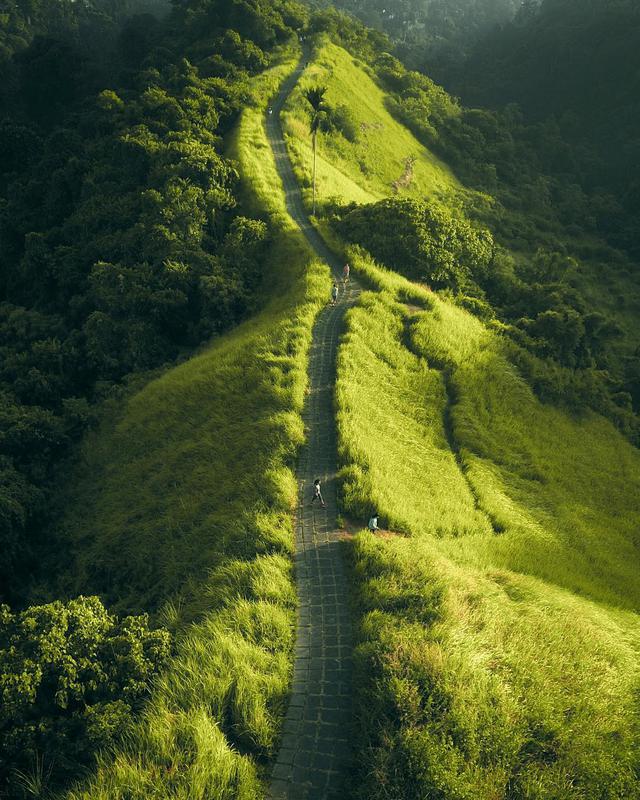
Two kilometres of open ridge between a riverside temple and the rice fields of Bangkiang Sidem, free and best before 8 am.
By the Baligasm editors · Updated 29 October 2026 · Photo by @sudarma_55
Overview
Campuhan Ridge Walk: before you go
The Campuhan Ridge Walk is a free, paved footpath on Ubud's western edge. It starts at Pura Gunung Lebah by the Campuhan bridge, about 1.5 km from Ubud Palace and roughly 38 km (75–120 minutes) from the airport, then runs 2 km north along a grassy ridge to the rice fields of Bangkiang Sidem. It suits anyone based in Ubud who can be out by 7 am. Allow 1.5–2 hours there and back.
Campuhan is the Balinese word for a confluence, and the walk begins at one. Below the road bridge west of central Ubud, two arms of the Wos River join, and the small hill between them holds Pura Gunung Lebah. Local tradition places the holy man Rsi Markandya here in the 8th century: he came over from Java, meditated where the waters meet, then travelled east to found Besakih. The temple's five-tiered meru is a seat for the gods of Pura Ulun Danu Batur, the lake temple near the river's source, and Ubud's own story is usually told from this spot.
From the stairs behind the temple, the path climbs onto the spine of land between the two valleys and heads north. It is paved throughout. Tall alang-alang grass, the kind used for thatched roofs, lines both sides, and jungle falls away into the river gorges. The ridge section lasts about 1.2 km. After that the path turns into a village lane through the paddies of Bangkiang Sidem. Trail signs give 2 km to Karsa Kafe, where most people turn round, so the full outing is about 4 km.
There is no gate, no ticket and no need for a guide. The trade-off is exposure: nothing on the ridge offers shade, so by 8:30 am the walk becomes hot work, and late afternoon brings a steady stream of runners, walkers and sunset photographers. Think of it as a pleasant hour in the open rather than a hike. The views are of treetops and valley jungle, and travellers who have already walked rice fields elsewhere in Bali will find the northern end familiar.
Getting to the start has changed. Since 8 September 2026, Ubud Main Road has run one-way eastbound through the centre, so cars coming from the east side of town must loop round, and walking is often faster. Bangkiang Sidem has also banned ride-hailing pickups inside the village, although drop-offs are allowed. If you plan to walk one way, book a driver for the north end or walk back along the ridge. As a free early walk from an Ubud base it is well worth doing. As a special trip from the coast, it is not.
- Opening hours
- Open access with no gate; no lighting after dark
- Ticket
- Free
- Time needed
- 1.5–2 hours return to Karsa Kafe, with stops
- Best time
- Between 6 and 7:30 am; for sunset, set off around 4:30 pm
- Dress code
- No dress code on the path; sarong and sash to enter Pura Gunung Lebah
- Location
- Campuhan bridge, about 1.5 km west of Ubud Palace
Pura Gunung Lebah, Campuhan Road, Ubud, Gianyar, Bali 80571
Open in Google Maps ↗Read it on the Blog →What to see
What to see at Campuhan Ridge Walk
Pura Gunung Lebah at the start
Your first few minutes follow the outer wall of Pura Gunung Lebah, which crowns the knoll between the two Wos streams. Gates and walls can be seen from the path for nothing. Stepping inside calls for a sarong and sash plus a donation of around IDR 10,000–20,000, and ceremonies close it to visitors. Save it for the return leg, when you are no longer racing the heat.
The open ridge
Stairs behind the temple lead up to the crest. From there the path follows the ridge line for about 1.2 km, with alang-alang grass on either side and the two Wos valleys dropping into jungle. At a steady pace this stretch takes 20 to 25 minutes. The few palms along the top give no real shade, and there is nothing to buy until the far end.
Bangkiang Sidem and its rice fields
When the ridge runs out, the trail turns into a lane leading to Bangkiang Sidem, an agricultural village surrounded by paddies. The mood shifts: small cafés, art stalls and a yoga studio sit along the lane, and the paddies open up on both sides. This is the best section for rice-field photos and the natural place to stop for a drink before turning back.
Karsa Kafe and Karsa Spa
Most walkers treat Karsa Kafe, roughly 2 km in, as the end point; its tables look over paddies and lotus ponds. Next door, Karsa Spa is open from 9 am until 7 pm, and an hour of Balinese massage is IDR 240,000, with 15% added for tax and service. Book a treatment and the walk becomes a half-day outing; spa clients also get a free ride back out of the village.
Penestanan on the way back
Once you are back at the bridge, cross over and climb the long flight of steps off Campuhan Road up to Penestanan. This is where Arie Smit, a Dutch painter, handed brushes to local children in the 1960s and sparked the Young Artists movement. Narrow lanes with no cars wind past paddies, villas and modest galleries. Allow an hour to loop around the village and come down again.
Seasons
Best time to visit Campuhan Ridge Walk
Start early. Bali has no daylight saving, and Ubud's sunrise moves between about 5:50 am in November and 6:35 am in July. Set off between 6 and 7:30 am for cool air, low light and an empty path. By around 8:30 am the open ridge is hot, with daytime highs near 29–30°C in every month and no cover at all.
Neither end of the ridge faces an open horizon, because it runs roughly north to south between two valleys. At sunrise the light spills over the eastern valley while the path is nearly deserted. Sunset warms the western side, but the path is at its most crowded and the ground still holds the day's heat. The sun goes down between about 6:05 and 6:45 pm and there are no lights, so turn back as it drops and pack a headlamp.
The dry season, April to October, is the most comfortable. In the wet months, November to March, afternoon storms turn the paved surface and stairs slick, so set out in the morning, ahead of the downpours. That is also when the grass and paddies look their greenest, and outside July, August and Christmas the path is noticeably quieter.
Getting there
How to get to Campuhan Ridge Walk
Ubud Palace15–20 minutes walking
Head west and downhill on Ubud Main Road towards the Campuhan bridge. Just short of it, take the Warwick Ibah driveway on the right, bear left where a sign reads “Going to the Hill”, and keep the temple wall beside you until the stairs.
Monkey Forest lobby30–35 minutes walking; 10 by car
Roughly 2.5 km: up Monkey Forest Road to the palace crossroads, then turn left along Ubud Main Road as far as the bridge.
Bangkiang Sidem (north end)About 10 minutes' drive from central Ubud
Drive via Sanggingan and Payogan, then walk the ridge south into town. A taxi from Ubud costs about IDR 100,000–150,000. App drivers can drop you in the village but cannot pick you up there.
Ngurah Rai Airport75–120 minutes
38 km by road to Campuhan Road on a transfer booked ahead.
Canggu, Seminyak or Kuta75–120 minutes
30–40 km by car. Reaching the ridge for sunrise means leaving before 5 am, so spend the night in Ubud instead.
Sanur45–60 minutes
25 km by car, the nearest beach base for an early start.
| From | Time | How |
|---|---|---|
| Ubud Palace | 15–20 minutes walking | Head west and downhill on Ubud Main Road towards the Campuhan bridge. Just short of it, take the Warwick Ibah driveway on the right, bear left where a sign reads “Going to the Hill”, and keep the temple wall beside you until the stairs. |
| Monkey Forest lobby | 30–35 minutes walking; 10 by car | Roughly 2.5 km: up Monkey Forest Road to the palace crossroads, then turn left along Ubud Main Road as far as the bridge. |
| Bangkiang Sidem (north end) | About 10 minutes' drive from central Ubud | Drive via Sanggingan and Payogan, then walk the ridge south into town. A taxi from Ubud costs about IDR 100,000–150,000. App drivers can drop you in the village but cannot pick you up there. |
| Ngurah Rai Airport | 75–120 minutes | 38 km by road to Campuhan Road on a transfer booked ahead. |
| Canggu, Seminyak or Kuta | 75–120 minutes | 30–40 km by car. Reaching the ridge for sunrise means leaving before 5 am, so spend the night in Ubud instead. |
| Sanur | 45–60 minutes | 25 km by car, the nearest beach base for an early start. |
Know before you go
Tips for your visit
- 01Carry at least a litre of water. Nothing is sold on the ridge until Bangkiang Sidem.
- 02Wear a hat and sunscreen. There is no shade anywhere on the crest, and the sun is fierce by mid-morning.
- 03Choose trainers or sandals with grip over flip-flops. Morning dew and rain make the paving slick.
- 04Use a toilet before setting off. The ridge has none, although customers can use toilets at the cafés up at the northern end.
- 05Nobody needs a ticket. Ignore anyone at the entrance asking for one; only parking and the temple carry charges.
- 06No ATM exists along the route, so carry small change for drinks, parking and any temple donation.
- 07Scooters can use a small lot along the Warwick Ibah driveway for roughly IDR 5,000, and a car costs around IDR 10,000–20,000 if space allows; otherwise park across the bridge near the Blanco Renaissance Museum. Bicycles usually park free.
- 08There is no proper loop. The road route back via Payogan and Sanggingan is about 7.7 km, mostly beside traffic, so most people return along the ridge.
- 09Steps at the start and a short flight near the north end rule out pushchairs and wheelchairs. Cyclists use the path too, so listen for bikes behind you on the narrow crest.
- 10Be back on the road before dark. The path is unlit and the steps by the temple are hard to see at dusk.
- 11Keep voices low near Pura Gunung Lebah and stay off its walls. It is an active temple and closes to visitors during ceremonies.
FAQ
Campuhan Ridge Walk questions, answered
How do I find the start of the walk?
+
Head for Pura Gunung Lebah beside the Campuhan bridge, roughly 1.5 km west of Ubud Palace on Campuhan Road. Just short of the bridge, turn into the Warwick Ibah driveway, take the left fork at the “Going to the Hill” sign and keep the temple wall on one side until you reach a staircase. A marker there puts Karsa Kafe 2 km ahead.
What distance does the walk cover?
+
About 4 km in total, as Karsa Kafe sits roughly 2 km from the temple. The open ridge accounts for around 1.2 km, or 20–25 minutes of steady walking, and the café is a further 5–10 minutes beyond it. Including photos and a drink at the far end, most people are back within 1.5 to 2 hours.
Do you have to pay?
+
No. It is a public path with no gate or fee, so anyone asking for a ticket at the start can be ignored. Your only spending is on parking, about IDR 5,000 for a scooter, and an optional donation of roughly IDR 10,000–20,000 should you decide to visit the inside of Pura Gunung Lebah.
Can I walk it at sunrise?
+
Dawn is ideal. Be at the temple by about 6 am, since sunrise ranges from 5:50 to 6:35 am through the year. You get cool air, an empty path and soft light coming across the eastern valley. The ridge lies between two valleys, though, so there is no open horizon for watching the sun itself appear.
Is dawn or dusk the better choice?
+
Dawn, for most walkers. It is cooler and calmer, and you finish with plenty of daylight. Evening light on the western slopes is pretty, yet the crowds are bigger, the ground is still hot and the return leg is in fading light with no lamps. Evening walkers should set off by 4:30 pm with a headlamp.
Will I find any shade?
+
Practically none. Apart from a few palms, the ridge is bare grass, so between about 8:30 am and late afternoon the sun is on you the whole way. Walk early or late, wear a hat and sunscreen, and take a litre of water or more, as there is nowhere to buy any before Bangkiang Sidem.
Where are the toilets?
+
There are none on the ridge, so go at your hotel or a café beforehand. Up at the Bangkiang Sidem end, Karsa Kafe and the other cafés and warungs keep toilets for paying customers, which makes a drink the simplest ticket to one.
Should I worry about safety?
+
Not in daylight: the path is paved, free of cars and well used. What deserves respect is the heat, the slippery stairs and paving after rain, and the total lack of lighting after sunset. Do not walk it alone at night, carry water and go carefully on the steps next to the temple.
What clothes and shoes work best?
+
Something light and breathable, plus a hat, sunglasses and trainers or grippy sandals. Flip-flops slide on damp paving, while boots are overkill on a paved surface. No dress code applies to the walk; only bring a sarong and sash if you intend to go into Pura Gunung Lebah.
Is a one-way walk possible?
+
It is, as long as the return is sorted. The route does not loop, and ride-hailing pickups are banned within Bangkiang Sidem. Arrange for a driver to collect you at the northern end, or do it the other way round: take a taxi up, around IDR 100,000–150,000 from Ubud, and stroll south into town.
Is the walk worth an early alarm?
+
If you are staying in Ubud, yes. It is free, close to the centre and gets you to valley views and paddies within an hour. Set out early, breakfast in Bangkiang Sidem and return via Penestanan. Driving up from the coast just for this, however, is hard to justify.
Nearby
Pair it with
Penestanan village
About 10 minutes on foot: cross the bridge and climb the stairway into the village where the Young Artists painters began, with paddies and quiet lanes.
Neka Art Museum
Balinese painting, the largest collection of Arie Smit's work and a hall of keris daggers, 5 minutes by car up the Sanggingan road.
Ubud Palace (Puri Saren Agung)
Royal courtyards and the nightly dance at the heart of town, 15–20 minutes on foot.
Sacred Monkey Forest Sanctuary
Do the ridge at dawn and arrive at the temple forest for its 9 am opening; 30–35 minutes on foot or 10 by car.
Tegallalang Rice Terrace
Bali's famous stepped paddies, north of town; get there around 7 am to beat the coach groups. 30–40 minutes by car.
More in Ubud