
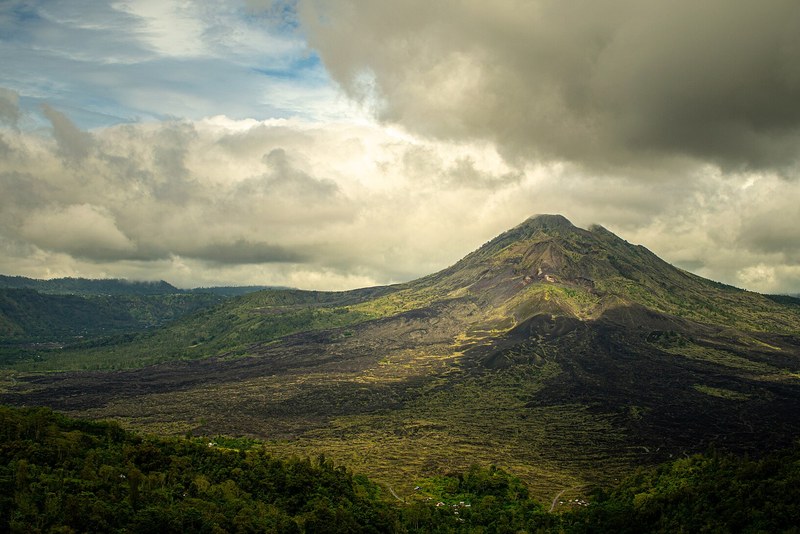
Kintamani · Adventure
Mount Batur Sunrise Trek, Kintamani
Two hours up loose volcanic grit in the dark, for dawn over Lake Batur and Mount Agung.
By the Baligasm editors · Updated 29 October 2026 · Photo: Philip Nalangan / Wikimedia Commons (CC BY 4.0)
Overview
Mount Batur Sunrise Trek: before you go
The Mount Batur sunrise trek is a guided night climb up the 1,717 m active volcano at the heart of Kintamani, 60 to 90 minutes north of Ubud. Walkers leave Toya Bungkah around 4 am, gain about 650 m in under two hours and watch daybreak over Lake Batur and Mount Agung. It suits reasonably fit travellers who can face a 2 am pickup, cold air and a busy summit.
Gunung Batur is the young cone that grew inside the Batur caldera, topping out at 1,717 m. Records of its activity begin with an eruption in 1804, and the latest ran from 1999 into 2000. Lava in 1926 swallowed the old village of Batur, which is why its temple, Pura Ulun Danu Batur, now stands on the rim above. On 15 October 2026 PVMBG, the national volcano agency, held Batur at Level I (Normal), the lowest of four steps, while telling visitors not to camp or hang around inside the active crater and to keep clear of its gas vents.
Short as it is, the climb is steep. Nothing about the route is technical or exposed, and the park authority, BKSDA Bali, scores it 1 to 2 out of 5, between easy and moderate. What makes it tiring is the grit, which slides under your boots, most of all on the way down. Groups typically leave the Toya Bungkah car park, at roughly 1,050 m, around 4 am, with headlamps and a village guide, and top out 1.5 to 2 hours later. Up there, shacks sell hot drinks and guides cook breakfast in the steam vents.
Going alone is not really an option. PPPGB, the association of Batur trekking guides, controls guided ascents, and every tour company hires its members. BKSDA backs the system: in 2023 the head of its Kintamani unit said visitors should climb with a guide, and the agency treats villagers as the mountain's official guides. Foreign climbers also owe BKSDA an IDR 100,000 entrance fee, normally bundled into the tour price.
Solitude is off the menu too. BKSDA logged 73,619 climbers in 2025, roughly 200 a day across the year and over 300 a day in June, against a government carrying-capacity limit of about 500 on the summit. On peak mornings the final ridge turns into a queue of headlamps. Access has wobbled: a 2023 ban on climbing Bali's mountains was announced but never enforced, the park shuts around Nyepi and for some village ceremonies, and in August 2026 two hectares of forest burned in a blaze thought to have started from a discarded cigarette. Anyone who dreads crowds or a 2 am alarm can watch much the same dawn from the Pinggan lookout or a jeep.
- Opening hours
- Walking starts 3:30–4 am; Ubud pickups around 2 am
- Ticket
- Tours IDR 300,000–700,000 a person, guide and park fee included
- Time needed
- 4–5 hours on the mountain; 8–10 hours door to door from Ubud
- Best time
- June to September for clear skies; April, May and October for fewer people
- Dress code
- Warm layers, a beanie and grippy shoes; no sarong needed
- Location
- Lakeshore at Toya Bungkah, Kintamani; 1–1.5 hours (43 km) from Ubud
Toya Bungkah Road, Kintamani, Bangli Regency, Bali
Open in Google Maps ↗Read it on the Blog →What to see
What to see at Mount Batur Sunrise Trek
The climb from Toya Bungkah
The usual start is a car park on the south-western edge of Toya Bungkah. Once everyone has a working headlamp and the guide has given a short briefing, sandy tracks lead across the lower slopes before giving way to open volcanic grit, with a pause every 20 to 30 minutes. After roughly 1.5 hours you reach a warung on the lower southern rim; the section above it, past a little shrine, is the hardest of the night. The descent takes about an hour and punishes the knees.
Sunrise from the summit
The eastern sky starts to glow some 20 minutes before the sun appears, at about 5:50 am in November and close to 6:30 am in July. It rises over the far rim of the caldera. To its right, Mount Abang, at 2,151 m the rim's highest point, and the perfect cone of Mount Agung stand in silhouette above Lake Batur. From December to March, cloud inside the caldera can blot out the whole scene.
Breakfast cooked by the volcano
Close to the top, steam leaks from cracks in the rock, and guides use the heat to cook eggs and bananas, usually served with bread and something hot to drink bought from the huts on top. Breakfast is part of most packages; if yours does not, budget around IDR 50,000. Macaques wait along the rim for leftovers and will grab unattended snacks and bottles, so keep food zipped away and never feed them.
The crater rim route
Fit walkers can extend the morning with the crater loop. It leaves the lower warung heading east along the rim, then climbs sharply to a second warung close to the highest point. For roughly half a kilometre after that, the path along the crater lip is narrow enough, and steep enough, that you may use your hands, and the ground beside it steams. Allow an extra hour, and heed the volcano agency's advice not to linger beside the gas vents.
Other trailheads
Toya Bungkah is the busiest start but not the only one. A steeper, quieter path climbs from Pura Jati in about 2 to 2.5 hours, and a longer route from Serongga winds through forest and farmland with few markers. A third option is to drive a rough track from the Songan road to a parking area high on the north-eastern flank, from where the top is about 45 minutes away on foot. Ask your operator which start it uses.
The sunrise jeep alternative
Non-hikers can ride a 4WD up sandy tracks to a sunrise lookout on the lower slopes, well short of the summit, and then cross the black lava left by the 1963–64 and later eruptions. The trade-off is engine noise, dust and a row of other jeeps. A private sunrise jeep for two from Batur Natural Hot Spring costs IDR 1,350,000 with fees and breakfast, and more with extra lava stops.
Hot springs afterwards
Pack swimwear: the Toya Bungkah hot springs are a few minutes' drive from the trailhead. At village-owned Batur Natural Hot Spring, open 7 am to 7 pm, a foreign adult ticket is IDR 200,000 (IDR 100,000 for a child), and a towel and locker come with it. Toya Devasya, close by, has eight natural pools plus an Olympic-size pool. Both fill up as trek groups come off the mountain, so go straight from the trail.
Seasons
Best time to visit Mount Batur Sunrise Trek
Aim for the dry season. Kintamani sees around 65 mm of rain spread over five days in August, compared with more than 400 mm across some 20 days in December and January. The clearest dawns and firmest footing come from June to September, while cloud regularly fills the caldera from December to March and wet grit becomes treacherous. April, May and October are a reasonable middle ground, with fewer climbers.
Numbers follow the holidays. In BKSDA's 2025 figures June was the peak month with 9,378 climbers, ahead of August and May, while January and February each stayed below 2,500. Most climbers are Indonesian, so school holidays and long weekends crowd the path, as do Christmas and New Year. Pick a weekday if you can.
Watch the calendar as well. The park closed from 18 to 20 March 2026 for Nyepi, which next falls on 8 March 2027. Village ceremonies occasionally shut the trail for a day or two, as happened in October 2023, so confirm with your operator the day before. Sunrise is earliest in November, at about 5:50 am, and latest in July, near 6:30 am.
Getting there
How to get to Mount Batur Sunrise Trek
Ubud1–1.5 hours
Trek vans leave around 2 am for the 43 km drive north via Tegallalang and Penelokan, finishing on the hairpins down to the lake.
Seminyak, Canggu or Kuta2–2.5 hours
Pickups come at about 1:15 am for a 74 km night drive. A night in Ubud first makes the morning much kinder.
Sanur1.5–2 hours
Collected around 1:30 am for a 64 km run north through Gianyar.
Uluwatu, Jimbaran or Nusa Dua2.5–3 hours
With pickups near 1 am and 83–94 km to cover, it is far easier to sleep in Ubud or by the lake the night before.
Ngurah Rai airport (DPS)2–3 hours
Around 76 km. Never plan the climb for arrival day; spend a night in Ubud or Kintamani and go the next morning.
Penelokan (Kintamani rim)15–20 minutes
Down the hairpins through Kedisan and along the shore, about 8 km. Sleep on the rim or by the lake and the alarm moves to around 3 am.
Lovina and the north coast1.5–2 hours
Via Singaraja and over the north rim at Penulisan, roughly 72 km.
| From | Time | How |
|---|---|---|
| Ubud | 1–1.5 hours | Trek vans leave around 2 am for the 43 km drive north via Tegallalang and Penelokan, finishing on the hairpins down to the lake. |
| Seminyak, Canggu or Kuta | 2–2.5 hours | Pickups come at about 1:15 am for a 74 km night drive. A night in Ubud first makes the morning much kinder. |
| Sanur | 1.5–2 hours | Collected around 1:30 am for a 64 km run north through Gianyar. |
| Uluwatu, Jimbaran or Nusa Dua | 2.5–3 hours | With pickups near 1 am and 83–94 km to cover, it is far easier to sleep in Ubud or by the lake the night before. |
| Ngurah Rai airport (DPS) | 2–3 hours | Around 76 km. Never plan the climb for arrival day; spend a night in Ubud or Kintamani and go the next morning. |
| Penelokan (Kintamani rim) | 15–20 minutes | Down the hairpins through Kedisan and along the shore, about 8 km. Sleep on the rim or by the lake and the alarm moves to around 3 am. |
| Lovina and the north coast | 1.5–2 hours | Via Singaraja and over the north rim at Penulisan, roughly 72 km. |
Know before you go
Tips for your visit
- 01Get the inclusions in writing: guide, BKSDA park fee, breakfast, headlamp, pickup, and whether the hot spring costs extra.
- 02Expect 8–18°C and wind at the top. Bring a fleece, a windproof layer, gloves and a hat, and keep a dry T-shirt and spare socks in your bag.
- 03Wear trail shoes or boots with proper grip. Poles help on the sliding descent, and many tours lend them.
- 04The evening before, look up Batur's current alert status on MAGMA Indonesia (magma.esdm.go.id).
- 05Do not smoke or drop litter on the mountain; a cigarette butt is thought to have started the August 2026 slope fire.
- 06Keep snacks zipped inside your bag, as monkeys on the rim snatch food and drinks.
- 07Carry small notes for summit drinks and donations. The Kintamani area fee, IDR 50,000 for foreigners, is collected at road posts from 8 am to 5 pm.
- 08Flying a drone in the park needs a BKSDA permit; its 2026 tariff sets drone use at IDR 2 million.
- 09A room by the lake, in Toya Bungkah or Songan, turns the 2 am van into a 3:30 am walk to meet the guide.
FAQ
Mount Batur Sunrise Trek questions, answered
Can I climb Mount Batur on my own?
+
Not realistically. The park authority, BKSDA Bali, wants every climber to go with a guide, and the guides' association, PPPGB, has a long record of confronting people who start without one. Every tour includes a PPPGB guide. Setting off alone risks an argument on the trail, a fee regardless, and a fall on loose grit in the dark.
What does the Batur sunrise trek cost?
+
Private treks with pickup, guide, park fee and breakfast run about IDR 700,000 for a solo climber, dropping to roughly IDR 300,000 each in a group of five. Tours sold by large booking platforms often start nearer IDR 500,000, and the guides' association quotes from about IDR 400,000 a person. Jeep trips cost more, and the hot springs normally sit outside the package price.
Is there a park fee on top of the tour?
+
Yes, though most packages include it. Foreigners pay BKSDA Bali IDR 100,000 to climb; Indonesian visitors pay IDR 10,000, rising to IDR 15,000 on public holidays. Separately, Bangli regency collects a IDR 50,000 Kintamani area fee from foreigners between 8 am and 5 pm, and Bali's IDR 150,000 tourist levy is paid once per trip. Ask which of these your price covers.
How fit do I need to be?
+
Moderately. BKSDA grades the route 1 to 2 on a five-point scale: you gain roughly 650 m over sandy volcanic grit in 1.5 to 2 hours, and there are no sheer drops. Just below the rim it gets steep, and many people find going down tougher than going up, since the grit rolls underfoot. If you can walk uphill for two hours with rests, you can do it.
How long is the trek from start to finish?
+
Most groups spend 4 to 5 hours on the volcano in all: up to two hours climbing, an hour on top for the sunrise and breakfast, then roughly an hour back to the car park. The crater route adds another hour. With a 2 am pickup from Ubud you are usually back by 10 or 11 am, or early afternoon if you stop at the hot springs.
When will I be picked up?
+
Roughly 2 am in Ubud, 1:30 am in Sanur, 1:15 am in Seminyak, Canggu or Kuta, and 1 am in Nusa Dua, Jimbaran or Uluwatu. Walking begins between 3:30 and 4 am, which gets groups to the top ahead of the sun. Staying in Toya Bungkah or Songan means meeting your guide at about 3:30 am instead.
Is the sunrise jeep tour a good alternative?
+
For children, sore knees or anyone who will not climb, yes. Jeeps reach a lookout on the lower slopes, beneath the summit, and then drive out over the black lava fields. You miss the crater and the sense of having earned the view, and you share the lookout with plenty of other jeeps. A private jeep for two costs about IDR 1,350,000.
How safe is Mount Batur?
+
Generally safe. On 15 October 2026 PVMBG had Batur at Level I (Normal), its lowest alert level, but warned people against camping or lingering in the active crater and near its vents. In reality the bigger risks are slipping on loose grit before dawn, cold wind on the summit and the pre-dawn drive on mountain roads.
How cold does it get on the summit?
+
Cold enough for a fleece and a beanie. Before dawn the top can be anywhere from about 8°C to 18°C, and wind on the rim makes it feel colder, especially once you stop moving and your sweat cools. Temperatures climb fast after sunrise, so wear layers you can peel off for the hot, dusty walk down.
Which months are best for the climb?
+
June to September, the core of the dry season, gives the best odds of a clear sunrise and a firm trail. April, May and October are quieter, with a little more cloud. December to March is the gamble, with rain and mist blotting out the view on many mornings. Nyepi (next on 8 March 2027) and the odd village ceremony close the park for a day or more.
Is Mount Batur open right now?
+
As of 16 October 2026, no official closure was in place. A provincial plan in 2023 to stop people climbing Bali's mountains came to nothing, and the forest fire of August 2026 did not lead to a closure. Expect short planned shutdowns, though: the park went quiet for Nyepi in March 2026 (the 18th to the 20th), and village ceremonies close it now and then, so ask your operator the day before.
Nearby
Pair it with
Batur Natural Hot Spring
Village-run volcanic pools on the lakeshore at Toya Bungkah, about 1 km and five minutes by car from the trailhead.
Penelokan rim and Batur Geopark Museum
The classic view over the caldera, plus a museum that explains how it formed (closed Fridays); 15–20 minutes by car, 8 km.
Pura Ulun Danu Batur
Bali's supreme water temple, rebuilt on the rim after the 1926 eruption buried its first site; 25–30 minutes by car, 12 km.
Besakih Temple
Bali's holiest temple complex, terraced up Mount Agung beyond the caldera's south-eastern rim; 45–60 minutes by car, 26 km.
Tirta Empul
A 10th-century spring temple with a purification ritual you can join on the drive back towards Ubud; 50–60 minutes by car, 25 km.