
Ubud · Temple
Goa Gajah (Elephant Cave): Visitor Guide
Bali's 11th-century Elephant Cave, its sunken pools and the river stairs most groups skip
By the Baligasm editors · Updated 29 October 2026 · Photo by @saraunderwood
Overview
Goa Gajah (Elephant Cave): before you go
Goa Gajah, better known as the Elephant Cave, is a sanctuary hewn from rock around the 11th century in Bedulu village, 5 km south-east of central Ubud and 60 to 110 minutes from the airport. Its entrance is a carved demon's gaping mouth. The cave itself is quick; the sunken pools and the stairway to the Petanu River take up the rest of an hour. Best for people already staying in Ubud. Allow 45 to 90 minutes.
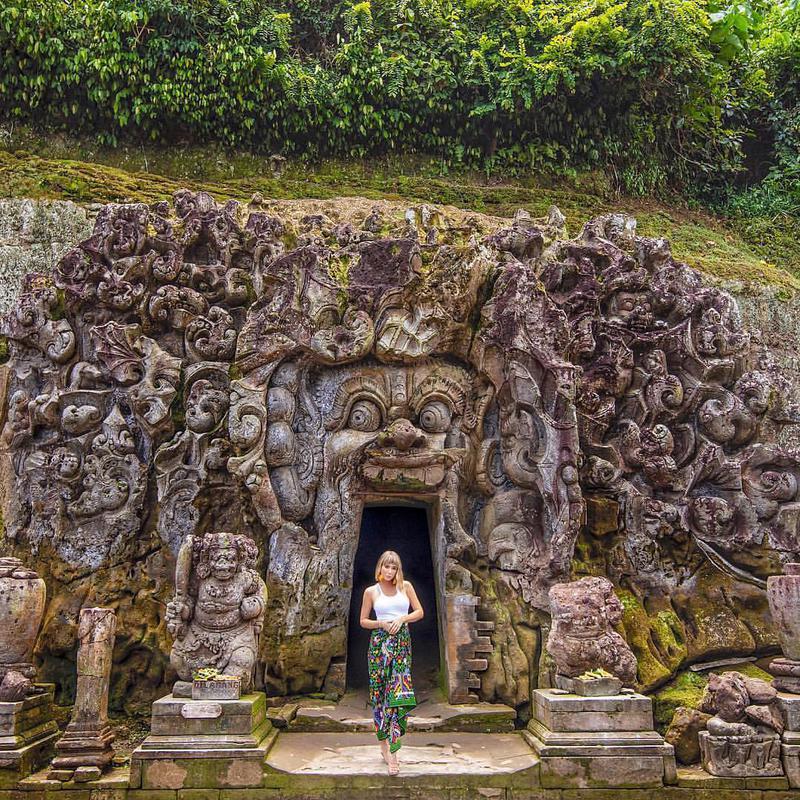
Carved into a rock face high above the Petanu River, the sanctuary probably dates from the 11th century, a period when Balinese kings still governed the island independently. A single colossal face, eyes bulging, frames the doorway, and visitors walk in through its mouth; the idea was to frighten evil spirits away. Local legend says the giant Kebo Iwa dug the entire cave using only a fingernail. A 1365 Javanese court poem, the Nagarakretagama, already mentions the place. Hindu and Buddhist elements sit side by side: inside are Ganesha and Shiva's lingam and yoni, while Buddhist stupas are carved into rocks near the river.
In 1923 Dutch archaeologists brought the cave back to attention. Excavation of the courtyard only started in 1954, revealing bathing pools edged with carved female figures who pour water from pitchers. Indonesia nominated the site to UNESCO's tentative list in October 1995, pulled it out in 2015 alongside several other entries, and by 2017 it no longer appeared. Despite claims in some tour descriptions, Goa Gajah holds no World Heritage status.
Worship continues here. Balinese families bring prayers to the shrines in the courtyard, the cave is often fragrant with incense, and all visitors must wrap a sarong around their waist. The route begins at the roadside, runs past a line of souvenir stalls to the ticket desk, where a sarong is handed over with your ticket, and then drops down a broad staircase into the courtyard with its cave and pools. Behave as you would in any active temple.
Keep expectations modest. The cave is cramped and dim, five minutes covers it, and plenty of people walk out disappointed. What justifies the stop is the lower section that tour groups tend to ignore, where stairs pass a vast banyan-like tree trailing roots and lead to the Buddhist carvings, a small waterfall and the riverbank, shaded and peaceful. At IDR 50,000 per adult it suits anyone already passing through Bedulu, ideally with Yeh Pulu added. If you only have time for one temple near Ubud, Tirta Empul or Gunung Kawi will reward you more.
- Opening hours
- Open every day, roughly 8 am–6 pm
- Ticket
- IDR 50,000 per adult, IDR 25,000 per child; sarong provided
- Time needed
- About 45 minutes; allow up to 1.5 hours if you walk down to the river
- Best time
- Right at the 8 am opening or late afternoon; river path is best April–October
- Dress code
- Sarong compulsory and provided; shoulders covered
- Location
- Bedulu, 5 km south-east of central Ubud (about 15 min)
Goa Gajah Road, Bedulu, Blahbatuh, Gianyar, Bali 80581
Open in Google Maps ↗Read it on the Blog →What to see
What to see at Goa Gajah (Elephant Cave)
The demon-face entrance
Around the doorway the rock has been worked into one massive face, with staring eyes and a wide-open mouth you walk straight through, while smaller figures swarm across the surrounding stone. At one time people saw an elephant in it, which may be where the name came from. For the whole facade in one frame, stand back by the pools, then move in to study the side reliefs that most people ignore.
Inside the cave
Through a narrow passage you reach a gloomy chamber, often hazy with incense. Ganesha, the elephant-headed god who clears obstacles, sits at one end; at the other is a shrine to Shiva in the form of three lingams, called the trilingga, resting on a yoni. A visit lasts minutes, and timing your entry for the moment a group leaves helps. Worship happens here, so talk softly and do not touch any statue.
The sunken bathing pools
Excavators only uncovered these pools in 1954. Along their sides, six stone women tip water from jars; there used to be seven until an earthquake destroyed one, and the set is commonly associated with India's seven sacred rivers. Treat them as an archaeological monument, not a place for a dip. Standing on the rim of the pools gives the best photograph of the entire site.
Hariti, the mother figure
Near the cave mouth is a statue of Hariti, whom the Balinese call Men Brayut, a maternal figure associated with fertility and the care of children. A young Dutch official from Singaraja uncovered her in 1923, at the same time as the Ganesha and the trilingga. Her serene expression is a counterweight to the snarling face above the entrance, and many visitors rush past her. Look for her before heading down towards the river.
Down to the Buddhist carvings
Tour groups mostly turn round at the pools. Keep walking, past a huge tree hung with aerial roots, and the stairs descend into the valley. By the stream, close to a small Buddhist temple, you find boulders carved with stupas and chattra, the tiered parasols placed on top of Buddhist shrines. Sometimes a local man offers to explain the history; agree on any payment up front.
The Petanu River and small waterfall
Where the stairs end, a little waterfall spills through the trees close to the Petanu, which the site's signs label the Elephant River. Do not expect a spectacle or a swimming hole; expect a cool, green and quiet contrast to the busy courtyard. There are no handrails on these steps, they get slippery once it has rained, and the walk back up is the hardest part of the whole visit.
Seasons
Best time to visit Goa Gajah (Elephant Cave)
Turn up as the gate opens at 8 am, or come after 4 pm. Coaches doing the Ubud temple loop start arriving mid-morning, and the small cave and pool area fills quickly. The early slot is also cooler for the uphill return from the river.
Save the river path for the April to October dry season if you can. In the rainy months, about November to March, the stone steps get muddy and slick; pack an umbrella and footwear that grips.
Festival days, including Galungan, Kuningan and the temple's own anniversary, can bring prayers into the courtyard. Should a ceremony be under way, stay well back from the people praying and check at the ticket desk which areas you may enter.
Getting there
How to get to Goa Gajah (Elephant Cave)
Ubud centreAbout 15 min
A 5 km drive or scooter ride south-east through Peliatan. In afternoon jams allow 25 minutes, especially while drivers adjust to Ubud's September 2026 one-way system.
Tirta Empul25–35 min
Take the Tampaksiring road south through Pejeng, around 14 km; most temple loops pair the two.
Sanur40–60 min
Roughly 23 km northwards by road.
Canggu or Seminyak60–110 min
Around 33–35 km by road. Combine it with Tegallalang and Tirta Empul on a day loop instead of making the journey just for this.
Ngurah Rai airport (DPS)60–110 min
Some 38 km by road. Because Bedulu lies on the southern route into Ubud, it works as an arrival-day stop, provided someone can keep an eye on your bags.
Nusa Dua or Uluwatu1.5–2.5 hours
A 50–55 km drive, sensible only as one stop within a full Ubud day.
| From | Time | How |
|---|---|---|
| Ubud centre | About 15 min | A 5 km drive or scooter ride south-east through Peliatan. In afternoon jams allow 25 minutes, especially while drivers adjust to Ubud's September 2026 one-way system. |
| Tirta Empul | 25–35 min | Take the Tampaksiring road south through Pejeng, around 14 km; most temple loops pair the two. |
| Sanur | 40–60 min | Roughly 23 km northwards by road. |
| Canggu or Seminyak | 60–110 min | Around 33–35 km by road. Combine it with Tegallalang and Tirta Empul on a day loop instead of making the journey just for this. |
| Ngurah Rai airport (DPS) | 60–110 min | Some 38 km by road. Because Bedulu lies on the southern route into Ubud, it works as an arrival-day stop, provided someone can keep an eye on your bags. |
| Nusa Dua or Uluwatu | 1.5–2.5 hours | A 50–55 km drive, sensible only as one stop within a full Ubud day. |
Know before you go
Tips for your visit
- 01Have cash for entry and for the roadside car park, which charges around IDR 5,000 per scooter and IDR 10,000 per car.
- 02Stallholders on the approach can be pushy; a friendly no while you keep walking does the job.
- 03A sarong is part of the ticket, but you still need clothing over your shoulders.
- 04Handrails line the main staircase to the courtyard, which most people manage. The path on to the river has none and is steep and uneven, so avoid it if your balance is poor or you are carrying a small child.
- 05Wear footwear that grips if the river is on your plan; flip-flops are a bad idea.
- 06Carry water, as the climb out of the valley is sticky and steep.
- 07Enter the cave right after a tour group leaves, when you get it almost to yourself.
- 08Balinese custom asks women who are menstruating not to enter the temple.
- 09Leave statues and offerings untouched, and stay quiet inside the cave.
- 10Ride-hailing cars will drop you off, but getting one back out of Bedulu can be slow; keep your driver or build the stop into a loop.
- 11Most tours skip Yeh Pulu, a 25 m rock relief only 1.6 km away. Add it.
FAQ
Goa Gajah (Elephant Cave) questions, answered
Is Goa Gajah worth the stop?
+
It is worth an hour if your base is Ubud or your route goes through Bedulu. Between the carved entrance, the old pools and the peaceful steps down to the river, it makes a rewarding short visit. Do not travel from the coast just for it: the cave is very small, and if you can fit in only one temple, Tirta Empul or Gunung Kawi will give you more.
What is the ticket price for Goa Gajah?
+
The current rate is IDR 50,000 per adult and IDR 25,000 per child, paid in cash at the desk, and the required sarong comes with it. Parking is extra: around IDR 5,000 per scooter and IDR 10,000 per car. Figures of IDR 15,000 or 30,000 still appear in places, but they are outdated.
When is Goa Gajah open?
+
Every day from around 8 am until 6 pm. A few listings still give 4 pm as closing time, so if you want to walk down to the river, aim to be there well before five. Crowds are thinnest in the first hour and during the final two hours before closing.
How much time does a visit take?
+
Roughly 45 minutes covers the courtyard, the pools and the cave. Continuing to the Buddhist carvings and the riverbank stretches it to between one and one and a half hours. Factor in about 15 minutes' drive in each direction from central Ubud, and an extra half hour if Yeh Pulu is on the list.
What will I find inside the cave?
+
A small, dark room, often filled with incense smoke, containing a Ganesha statue and a Shiva shrine made of three lingams on a yoni pedestal. You will have seen it in a few minutes. Most of the visit is actually spent outside, at the pools, the statue of Hariti and the Buddhist reliefs by the stream.
Where does the name Elephant Cave come from?
+
No one can say with certainty. One theory is that early visitors mistook the face over the entrance for an elephant; another points to the Ganesha statue inside; a third to the river below, signposted as the Elephant River. Goa is Indonesian for cave and gajah for elephant, so each explanation fits.
Does Goa Gajah have World Heritage status?
+
No. Indonesia added it to UNESCO's tentative list, a register of candidate sites, in October 1995, then withdrew it in 2015, and it was gone from the list by 2017. The single World Heritage inscription on Bali is the Cultural Landscape of Bali Province, inscribed in 2012 and centred on subak irrigation.
What is the dress code at Goa Gajah?
+
Cover your shoulders and choose shoes that grip. Everyone has to wear a sarong, but the ticket includes one, so you need not bring your own. If you intend to go down the stone steps to the river, leave the flip-flops behind, because those steps are slippery and have nothing to hold on to.
How many steps are involved?
+
Quite a few. From the ticket desk, a long staircase with handrails takes you down to the cave, and you have to climb back up when you leave. Beyond the courtyard, the route to the river is steeper and rougher, with no handrails. The main flight is fine for most people; those with unsteady legs should stop at the courtyard.
How long is the drive from Ubud?
+
Bedulu is 5 km south-east of central Ubud, around a quarter of an hour by car or scooter, more when the afternoon traffic builds. The village sits on the Gianyar road, which makes it simple to add nearby Yeh Pulu and, some 14 km north, Tirta Empul.
Is it easy to combine Goa Gajah with Yeh Pulu?
+
Very, and carving enthusiasts should. Yeh Pulu lies 1.6 km down the road, five minutes' drive, and features a 25 m relief from the 14th century depicting everyday village scenes. It draws a fraction of Goa Gajah's visitors and charges a small separate entry fee, so hold back some cash.
Nearby
Pair it with
Yeh Pulu
About 5 min by car (1.6 km). A 14th-century relief of village life, 25 m long, cut into a rock wall; rediscovered in 1925 and rarely busy.
Sacred Monkey Forest Sanctuary
15–20 min by car (5 km). Over 1,000 macaques, ravines and temples where Monkey Forest Road ends.
Tegenungan Waterfall
20–30 min by car (9 km). Ubud's nearest big waterfall, around 200 steps above a broad pool.
Tirta Empul
25–35 min by car (14 km). A spring temple where visitors take part in melukat purification beside Balinese families.
Tegallalang Rice Terrace
30–40 min by car (12 km). The island's most photographed terraces; go before nine.
More in Ubud