
Ubud · Culture
Ubud Palace (Puri Saren Agung)
Royal home by day, open-air dance stage by night, right at Ubud's main junction.
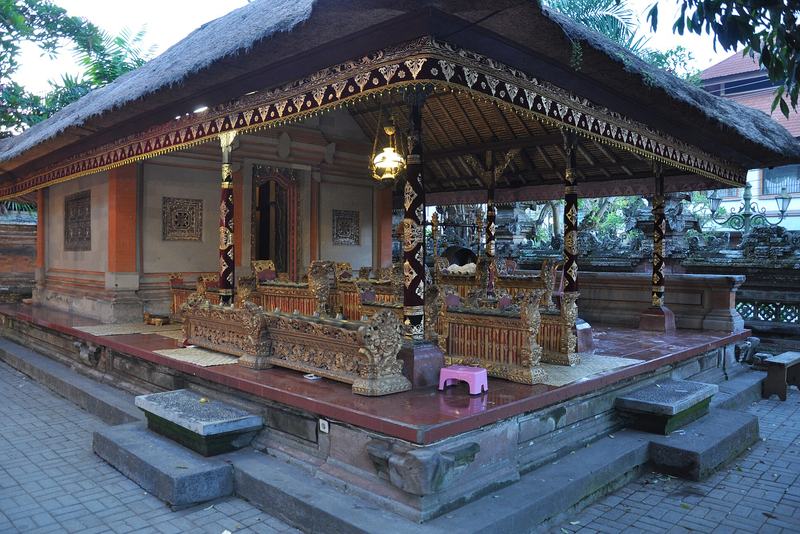
By the Baligasm editors · Updated 29 October 2026 · Photo: Jorge Láscar / Wikimedia Commons (CC BY 2.0)
Overview
Ubud Palace (Puri Saren Agung): before you go
Puri Saren Agung, better known as Ubud Palace, is where Ubud's royal family still lives. It stands at the town's main junction, where Monkey Forest Road meets Ubud Main Road, facing the art market and roughly 38 km (75–120 minutes) from the airport. Daytime entry to the front courtyards is free and takes 20 minutes. Evenings are the reason to come: a gamelan-accompanied dance at about 7:30 pm, with tickets around IDR 100,000.
The palace has two quite different personalities. Before dusk you can stroll into the outer courtyards without paying, look at the carving and leave. After dark, the same space becomes Ubud's most famous stage. Every night at about 7:30 pm a troupe performs to a live gamelan orchestra, and around IDR 100,000 buys a seat. Which dance you see depends on the day of the week: Legong, Barong or the Ramayana.
The compound took its current shape under Tjokorda Putu Kandel, ruler from 1800 to 1823. An earthquake in 1917 caused heavy damage, and much of the carving on the gates is attributed to I Gusti Nyoman Lempad, a local sculptor and temple builder born around 1862 who died in 1978. From 1928 the palace hosted foreign guests. In 1936 the princes Tjokorda Gde Agung Sukawati and Tjokorda Gde Raka Sukawati set up the Pita Maha artists' cooperative alongside the painters Walter Spies and Rudolf Bonnet, and Lempad was later commissioned to build Pura Taman Saraswati nearby, completed in 1952.
Descendants of the Sukawati line occupy the inner compound, which is why that part, and the family temple of Pura Marajan Agung, are closed. The family has never stepped back from public life. Tjokorda Gde Agung Suyasa, family head until he died in 2008, spent three decades as bendesa, leader of Ubud's customary village. Tjokorda Oka Artha Ardana Sukawati, son of the Pita Maha co-founder, went on to serve as regent of Gianyar (2008–2013) and deputy governor of Bali (2018–2023).
When a senior royal dies, Ubud stops. For Suyasa's cremation on 15 July 2008, some 15,000 people lined the streets as an 11-tonne, 28-metre tower with nine roofs carried his body to the Dalem Puri cemetery; 68 commoners and two royal relatives were cremated at the same time. Further royal cremations came in 2011, 2013 and July 2023. On an ordinary day, though, the open area is small and fills between 3 and 5 pm, and the dance means plain seats, no fans and no reservations. The market opposite lost one of its two buildings to fire on 17 August 2024.
- Opening hours
- Front courtyards roughly 8 am to 6 pm daily; dance from about 7:30 pm
- Ticket
- Free by day; around IDR 100,000 for the evening show
- Time needed
- Under 30 minutes in daylight; allow 2 hours for the dance including arrival
- Best time
- Early morning for the courtyards; seated by 7 pm for the dance
- Dress code
- Modest dress, shoulders and knees covered; no sarong required
- Location
- Main junction of central Ubud, across from the art market
Ubud Main Road No. 8, Ubud, Gianyar Regency, Bali 80571
Open in Google Maps ↗Read it on the Blog →What to see
What to see at Ubud Palace (Puri Saren Agung)
Gateways
Entry is straight off Ubud Main Road into the outer courtyard. Spend a minute on the gate in front of you. Above the opening a kala face scowls down; guardians on either side hold clubs, daggers and blossoms; the doors themselves are carved timber highlighted with gold leaf. Lempad, who reached the age of about 116, is credited with much of the stone, and large parts of the compound date from the rebuilding after 1917.
Pavilions
Beyond the gate, open pavilions stand on carved plinths, statues guarding their stairs; some hold the gamelan sets used in the evening. Walking between the outer courtyards is fine, but climbing onto or sitting in a pavilion is not. Shut doors deeper in signal the start of the family's private quarters and their temple, Pura Marajan Agung. Allow 15–30 minutes, a little more if you want to sit in the shade before the afternoon rush.
The evening show
At night, rows of chairs are set out in front of a richly carved gate with guardian statues, which forms the backdrop, and the gamelan plays live. Shows begin around 7:30 pm and last 75–90 minutes. Expect a sequence of short dances rather than a single drama; one Legong piece can be over in 15–20 minutes. The price is about IDR 100,000, and seating is unnumbered.
Which night, which dance
Legong is the staple, on Monday and Saturday, with its Mahabharata version on Sunday. Tuesday belongs to the Ramayana Ballet and Friday to the Barong. Wednesday mixes Legong with Barong, and Thursday is a Legong trance programme. Different troupes from Ubud and surrounding villages take turns, and Thursday is the least predictable night, so check with the ticket sellers before buying.
Legong
This dance most likely grew up in the 19th century as court entertainment for Balinese kings, which is why it looks so at home in a palace. The performers were traditionally young girls who began training at around five. Its most famous episode comes from the Malat tales: the king of Lasem kidnaps Princess Rangkesari and sets off to battle, until a giant raven warns him he will die. An attendant figure, the condong, dances first and hands fans to the two principals. UNESCO listed Legong in 2015.
Barong and the Ramayana
Seen Legong already? Pick Friday or Tuesday. The Barong, a lion-like guardian spirit, is danced by two men sharing one costume; in its clash with the witch Rangda, entranced followers turn their daggers on themselves, and the struggle between good and evil is left unresolved. Tuesday's Ramayana Ballet retells the epic in which Rama rescues Sita from the demon king Rawana, told in movement and gamelan, with none of the chanting chorus that defines Kecak.
Royal ceremonies
Ubud's grandest rituals start at the palace gate. Before a royal cremation, men from the town's villages construct a nine-tiered tower next to the palace, then take turns hauling it to the Dalem Puri cemetery a kilometre east. In 2011 some 4,500 residents were due to carry a 24-metre tower; in July 2023 around 1,500 bearers shared the job. Priests set the date, usually one to four months after a death, so catching one is chance.
Seasons
Best time to visit Ubud Palace (Puri Saren Agung)
Mornings are best for the courtyards; mid-afternoon, from roughly 3 to 5 pm, is when tour groups finishing at the market spill across the road. Getting up early has a second reward: the market opposite is still a local one, full of vegetables, flowers and offering materials, before souvenir traders set up from mid-morning.
Choose the evening by its programme, then aim to be seated by 6:45–7 pm if you want the front row. Performances run from about 7:30 pm to roughly 9 pm. The dry months, April to October, are kinder for an outdoor show. In the wet season, November to March, the courtyard has no roof, so pack a light layer and check with the seller what the plan is if rain sets in.
Holy days reshape the centre. For Galungan, next on 13 January 2027, bamboo penjor arch over Ubud Main Road, and Kuningan comes ten days after. There is no show on Nyepi, 8 March 2027, when Bali stays indoors. Royal cremations shut the surrounding streets for a day and send traffic on diversions around the centre.
Getting there
How to get to Ubud Palace (Puri Saren Agung)
Elsewhere in central Ubud5–20 minutes walking
The palace marks the main crossroads. From the Monkey Forest lobby it is about 1.2 km up Monkey Forest Road (15–20 minutes); from the Campuhan bridge it is a similar walk east on Ubud Main Road. Walk in single file on the narrow pavements.
Sayan or Kedewatan15–30 minutes' drive
4–7 km along the Ayung gorge road. Many resorts there run an evening shuttle; if yours does not, have a driver wait for the show to end.
Ngurah Rai Airport75–120 minutes
38 km by car on a pre-booked transfer. Evening traffic is the heaviest, so landing and catching a show the same night rarely works.
Kuta, Legian or Seminyak75–120 minutes
34–36 km. Set off by 5:30 pm for the 7:30 pm show and expect to be home after 10:30 pm.
Canggu75–120 minutes
31–33 km by car or scooter; no direct shuttle runs. Denpasar traffic is the variable, and it makes for a long ride back.
Sanur45–60 minutes
22–25 km, the most convenient beach base for an Ubud evening.
Nusa Dua or Uluwatu1.5–3 hours
42–54 km. Too far for a round trip around one show; stay in Ubud for a night or two.
| From | Time | How |
|---|---|---|
| Elsewhere in central Ubud | 5–20 minutes walking | The palace marks the main crossroads. From the Monkey Forest lobby it is about 1.2 km up Monkey Forest Road (15–20 minutes); from the Campuhan bridge it is a similar walk east on Ubud Main Road. Walk in single file on the narrow pavements. |
| Sayan or Kedewatan | 15–30 minutes' drive | 4–7 km along the Ayung gorge road. Many resorts there run an evening shuttle; if yours does not, have a driver wait for the show to end. |
| Ngurah Rai Airport | 75–120 minutes | 38 km by car on a pre-booked transfer. Evening traffic is the heaviest, so landing and catching a show the same night rarely works. |
| Kuta, Legian or Seminyak | 75–120 minutes | 34–36 km. Set off by 5:30 pm for the 7:30 pm show and expect to be home after 10:30 pm. |
| Canggu | 75–120 minutes | 31–33 km by car or scooter; no direct shuttle runs. Denpasar traffic is the variable, and it makes for a long ride back. |
| Sanur | 45–60 minutes | 22–25 km, the most convenient beach base for an Ubud evening. |
| Nusa Dua or Uluwatu | 1.5–3 hours | 42–54 km. Too far for a round trip around one show; stay in Ubud for a night or two. |
Know before you go
Tips for your visit
- 01Tickets are sold at the palace gate and by sellers along Ubud Main Road from about 5 pm; online resellers ask roughly the same.
- 02Pay cash: neither the gate sellers nor the parking attendants accept cards.
- 03Get there 30–45 minutes ahead. With unreserved, basic seating, the front rows go first; choose an aisle if you might slip out early.
- 04It is open-air and fan-free, so bring water and mosquito repellent for humid nights.
- 05No flash, no wandering during the dances, and no standing up in front of the people behind.
- 06Keep off the pavilions and out of any doorway marked private. Beyond them is a family home.
- 07Traffic has changed. Since 8 September 2026 Ubud Main Road has been one-way heading east from the palace junction to the Arjuna statue, forcing drivers from the east into a loop. Tour coaches can no longer enter the centre and set down at Dalem Puri, 15 minutes' walk away. Walking is usually quicker.
- 08The palace has no car park of its own. Ubud Central Parking, by the market, charges around IDR 10,000 per car; side-street lots run about IDR 10,000–20,000. Cars pulling over on Ubud Main Road between 5 and 7 pm are what block the junction.
- 09Drop-offs by app drivers are fine, but local transport groups object to pickups here. After the show, walk a few hundred metres to a quieter street or book a local driver.
- 10Gate hours drift between about 7 or 8 am and 5 or 6 pm. Shut? Cross to the market and try again later.
- 11Just west of the market on Ubud Main Road, the Bina Wisata tourist office has leaflets on current events and other dance venues, Kecak nights included.
- 12Pura Taman Saraswati is 150 metres to the west and the market is across the road; an hour covers all three.
FAQ
Ubud Palace (Puri Saren Agung) questions, answered
Do you pay to go into Ubud Palace?
+
Not in the daytime. The outer courtyards of Puri Saren Agung are open with no ticket or reservation. Money only comes into it for the night-time dance, roughly IDR 100,000 a head, and for parking if you arrive by car. The family's inner compound and temple are off limits.
When can you visit the courtyards?
+
Generally from about 8 am to 6 pm every day, though the gates may open at 7 am or close at 5 pm on some days. Early morning is the quietest time and mid-afternoon, about 3 to 5 pm, the busiest. The 7:30 pm dance is separate and requires a ticket.
When does the evening performance start and end?
+
It begins at about 7:30 pm and runs for 75–90 minutes, so you are out around 9 pm. Seats are not allocated, which means people who want the front row turn up between 6:45 and 7 pm. Each night has a different programme; find out what is on before paying.
What do dance tickets cost?
+
Usually about IDR 100,000, sometimes up to IDR 150,000. Sellers work the palace gate and Ubud Main Road from about 5 pm and want cash; online resellers charge much the same. Whatever you pay, the ticket gets you in but not a specific seat, so arriving early still pays off.
What is the weekly dance schedule?
+
Most weeks follow this pattern: Legong Mahabharata on Sundays, Legong on Mondays and Saturdays, Ramayana Ballet on Tuesdays, Legong and Barong on Wednesdays, a Legong trance show on Thursdays and Barong on Fridays. Thursday changes most often and troupes rotate, so double-check with the sellers at the gate.
Is the palace worth an evening?
+
Yes, particularly for a first taste of Balinese dance: a live gamelan in a working royal courtyard is remarkable value. The daytime visit is a pleasant free stop if you are already in town, but not worth a trip from the coast on its own. Hard chairs and humid air put some people off the show.
Is the palace still a royal residence?
+
It is. The Sukawati family, descended from Ubud's former rulers, occupies the inner compound, which explains why so much is closed. They continue to lead the town's biggest ceremonies, and family members have held office: Tjokorda Oka Artha Ardana Sukawati served as regent of Gianyar (2008–2013) and as Bali's deputy governor (2018–2023).
Is there a dress code?
+
Cover your shoulders and knees. Because this is a royal home and not a temple, a sarong is not required in the courtyards or at the performance. On dance nights, light clothing helps in the fan-free courtyard; add a thin layer and some insect repellent for later in the evening.
Where can I see Kecak in Ubud?
+
Not at the palace, where the regular programme sticks to Legong, Barong and the Ramayana Ballet. Pura Dalem Taman Kaja holds Kecak at 7 pm on Mondays and Fridays, and Pura Taman Saraswati, 150 metres west, sometimes adds Tuesday and Thursday performances. Times change, so confirm on the day or at the tourist office.
Will I see a royal cremation?
+
Only if your timing is lucky. They follow the death of a senior royal, usually one to four months later, on a day fixed by priests. The latest took place in 2008, 2011, 2013 and July 2023; on each occasion bearers hauled a nine-tiered tower across town to Dalem Puri cemetery. Watching from the roadside is fine; dress modestly and stay out of the bearers' path.
How long is the transfer from the airport?
+
The palace is around 38 km from the airport, which takes 75 minutes to two hours by road. Seminyak and Kuta are about 35 km away with similar times, and Sanur 22–25 km, roughly 45–60 minutes. Coming from the coast for the 7:30 pm show, leave by 5:30 pm with a driver booked for the ride home.
Nearby
Pair it with
Ubud Art Market
Right across the street: fresh produce and offering supplies at dawn, rattan bags, sarongs and carvings later in the morning. Haggle with a smile.
Pura Taman Saraswati
Lempad's temple to Saraswati, goddess of learning, set behind a lotus pond and built for the royal family in 1951–52; it hosts evening dances too. 150 metres west.
Museum Puri Lukisan
Ubud's oldest art museum, founded in 1956 by the palace's Pita Maha circle, with shaded gardens; 300 metres west.
Sacred Monkey Forest Sanctuary
Some 1,000 macaques, three temples and a banyan-filled ravine at the far end of Monkey Forest Road; 15–20 minutes' walk.
Campuhan Ridge Walk
A free, sun-exposed ridge path out to the rice fields; do it at dawn and pass the palace on your way back. 15–20 minutes on foot.
More in Ubud