
Ubud · Nature
Sacred Monkey Forest Sanctuary, Ubud
Padangtegal village's sacred forest, its temples and roughly a thousand macaques, at the foot of Monkey Forest Road.
By the Baligasm editors · Updated 29 October 2026 · Photo by @meryldenis
Overview
Sacred Monkey Forest Sanctuary: before you go
Ubud's Sacred Monkey Forest Sanctuary covers 12.5 hectares at the southern end of Monkey Forest Road, about 38 km (75–120 minutes) from the airport. Roughly 1,000 long-tailed macaques share it with three temples from the 14th century, a stream-cut ravine and a sacred spring. Entry is IDR 130,000 for adults, and most visits last 60–90 minutes. Ideal for first-timers who are relaxed around bold wildlife; skip it if a monkey climbing on you sounds like a nightmare.
Its Balinese name, Mandala Suci Wenara Wana, means sacred forest of the monkeys. The land belongs to Padangtegal village: villagers make up the governing council, pray at the three temples and bury their dead in the forest cemetery. Their temple chronicle dates the temples to around the mid-1300s. Management follows Tri Hita Karana, the Balinese belief that wellbeing depends on balance between humans, nature and the divine.
Monkeys inhabit several of Bali's temple forests, including Sangeh and Uluwatu, where locals regard them as belonging to the holy site, not as entertainment. Here, keepers put out food nine times daily, sweet potato above all, plus bananas, papaya leaves and other produce. The population has risen sharply, from around 600 in 2011 to roughly 1,054 now, in seven troops each named for its patch of forest. An extra block of woodland was planted during the 1990s to give them space.
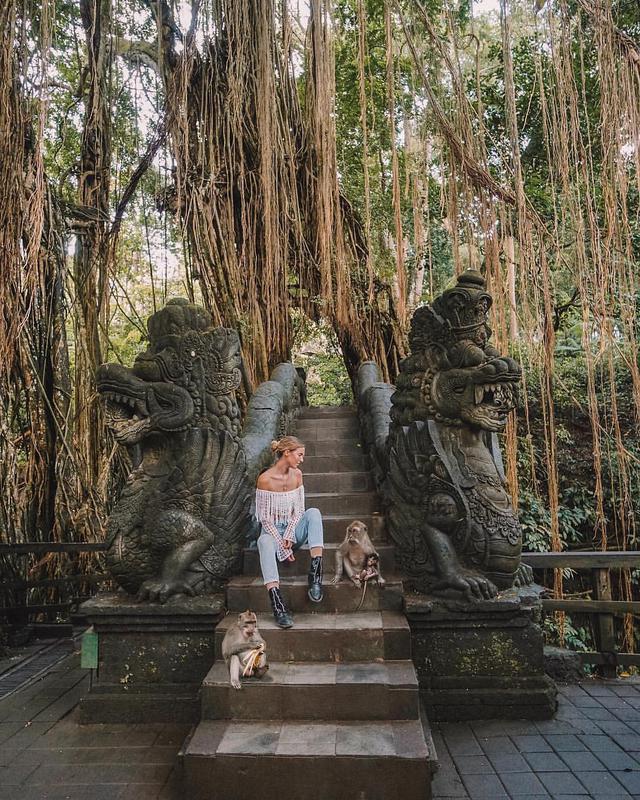
Inside, stone stairs and paved trails run beneath tall trees, past moss-covered carvings and down into a ravine with a stream. No barriers stand between people and monkeys. Macaques lounge on handrails, groom each other on the trail, splash in the central pond and scale anyone who looks like they might have food. Worship is the only reason to enter the temples, though their gateways and carving are clearly visible from outside.
There are real drawbacks. Being in the middle of town, the forest gets busy with tour groups by late morning. Hats, sunglasses, earrings and bottles regularly go missing, as does anything carried in plastic, and some visitors get bitten, usually after touching or feeding them. Driving in is a gamble too: on 8 September 2026, the first day of Ubud's one-way system, Monkey Forest Road and Hanoman Road were at a standstill for over four hours. For a first Bali trip the ticket is good value. Anyone who has met the Uluwatu macaques, or who hates being grabbed at, can give it a miss.
- Opening hours
- 9 am to 6 pm daily (last entry 5 pm); closed for Nyepi
- Ticket
- Adults IDR 130,000; children IDR 100,000
- Time needed
- 60–90 minutes, or about 2 hours with photos and the monkey selfie
- Best time
- At the 9 am opening, or from 4 pm
- Dress code
- No sarong required; keep it modest and wear grippy shoes
- Location
- Bottom of Monkey Forest Road, a 15–20 minute walk south of Ubud Palace
Monkey Forest Road, Padangtegal, Ubud, Gianyar, Bali 80571
Open in Google Maps ↗Read it on the Blog →What to see
What to see at Sacred Monkey Forest Sanctuary
Pura Dalem Agung Padangtegal
The largest temple lies in the forest's south-west corner. Its main deity is Shiva the transformer, with further shrines for the goddess Durga. Being the village's temple of the dead, it is linked to the cemetery and cremation temple across the forest. Entry is for worshippers in ceremonial dress only, but the carved gate and its guardians can be admired from the path. One troop, the Temple group, lives around it.
Pura Beji and the dragon bridge
Down in the north-western ravine, the Holy Spring Temple, Pura Beji, encloses a spring devoted to Gangga, the river goddess. Before ceremonies, villagers bring temple effigies here for purification, and people come for melukat, the holy-water cleansing. It is closed to visitors, yet the descent past dangling banyan roots to the stream, and a stone bridge flanked by dragon statues, make this the forest's most memorable stretch. Coins in the spring pool are wishes.
Pura Prajapati
In the north-eastern part of the forest, Pura Prajapati honours Brahma Prajapati, believed to guard the souls of the dead until they are cremated. Alongside is the Padangtegal cemetery, used for temporary burials until the next mass cremation, held about once every five years or on a favourable calendar date. Treat it as an active burial ground and lower your voice. The Cemetery troop has its territory here.
The banyan and the pond
All the main paths meet in the middle of the forest at a banyan tree reckoned to be over a century old, beside a pond used by the monkeys for drinking, swimming and bathing. This is where to watch daily troop life: infants feeding, youngsters chasing each other into the water, and keepers turning up with sweet potato. Signs point from here to each of the three temples.
Carvings worth slowing down for
The stonework is full of stories. Near the lobby stand Durga with her tiger and Sri, goddess of rice. Further in, there is a tiny cave sanctuary containing a Shiva lingga beside a relief showing Durga at her most terrifying. Close by, a split gate decorated with serpents and an owl, the bird that heralds death, symbolises the mountain and its forest. Most visitors rush by; take your time.
The troops and their babies
Roughly 1,054 macaques divide into seven troops, Cemetery, Central, Michelin, East, Temple, South and New Forest, each holding its own ground. In dry months, troops have to pass through rivals' territory to reach water, one of the triggers for fights. Grown males weigh up to about 8 kg. Most mating happens between May and August, and with a pregnancy of around six months, the newest babies appear towards the end of the year.
Selfies and weekend dance
Touching the monkeys is only permitted with staff present. For IDR 50,000 you can buy a monkey selfie voucher, and a handler will coax a macaque into sitting with you for a picture. Balinese dance is programmed for the open-air stage next to Wana Café twice each weekend day, at 11 am and 4 pm. Check in the lobby that it is on before building a day around it.
Seasons
Best time to visit Sacred Monkey Forest Sanctuary
Be there for the 9 am opening. Early on, the trails are less crowded, the air under the canopy is cooler and the monkeys tend to be more relaxed than in the noisy middle of the day. Groups pour in from mid-morning until early afternoon. Things calm down again after 4 pm, though entry stops at 5 pm and some troops will have moved further into the trees. With nine feedings spread across the day, timing for a feed hardly matters.
In the dry season, April to October, the stone steps are at their safest. November to March brings rain and slippery moss, but the trees give shade and the forest is lusher and quieter. Peak crowds come in July, August and over Christmas. Since most mating takes place in mid-year, newborns are easiest to spot from late in the year.
The forest is open daily apart from Nyepi, the island-wide day of silence, which next falls on 8 March 2027. Temple anniversaries and other festivals bring villagers through the forest in ceremonial clothes, offerings balanced in their hands; move aside, and never cross in front of someone at prayer.
Getting there
How to get to Sacred Monkey Forest Sanctuary
Ubud Palace, central Ubud15–20 minutes walking
About 1.2 km straight down Monkey Forest Road, lined with shops and cafés. Pavements are narrow and uneven, so walk one behind the other.
Pengosekan or Nyuh Kuning5–15 minutes walking
Each village is around 1 km away, to the south and east, an easy stroll to the lobby.
Ngurah Rai Airport75–120 minutes
38 km by road to central Ubud on a transfer booked ahead.
Canggu, Seminyak or Kuta75–120 minutes
30–40 km by car. Denpasar's traffic sets the pace; to be there near opening, leave before 8 am.
Sanur45–60 minutes
25 km by car, the most convenient beach base for an Ubud morning.
Nusa Dua or Uluwatu1.5–3 hours
45–60 km, one of the island's slowest regular drives at peak hours. Build a full Ubud day around it.
| From | Time | How |
|---|---|---|
| Ubud Palace, central Ubud | 15–20 minutes walking | About 1.2 km straight down Monkey Forest Road, lined with shops and cafés. Pavements are narrow and uneven, so walk one behind the other. |
| Pengosekan or Nyuh Kuning | 5–15 minutes walking | Each village is around 1 km away, to the south and east, an easy stroll to the lobby. |
| Ngurah Rai Airport | 75–120 minutes | 38 km by road to central Ubud on a transfer booked ahead. |
| Canggu, Seminyak or Kuta | 75–120 minutes | 30–40 km by car. Denpasar's traffic sets the pace; to be there near opening, leave before 8 am. |
| Sanur | 45–60 minutes | 25 km by car, the most convenient beach base for an Ubud morning. |
| Nusa Dua or Uluwatu | 1.5–3 hours | 45–60 km, one of the island's slowest regular drives at peak hours. Build a full Ubud day around it. |
Know before you go
Tips for your visit
- 01Food, snacks, drinks and plastic bags are all banned. Leave them in the lockers in the lobby, which are there for that purpose.
- 02Before you go in, stow sunglasses, hats, earrings, necklaces and phones in a zipped bag. Anything shiny or edible-looking is a target.
- 03Do not hold a monkey's gaze; the sanctuary says direct eye contact can be taken as a challenge.
- 04No touching, lifting or feeding, and that includes peanuts and bananas. Feeding is the keepers' job, and most bites happen when visitors break this rule.
- 05If a macaque lands on you, stay quiet and do not run. Stand, walk slowly and signal to a staff member; it normally hops off within seconds.
- 06A bite or scratch means a visit to the on-site clinic for first aid, followed by a doctor's appointment that day to discuss rabies jabs.
- 07Keep small children by the hand and toys out of sight; children trying to play with monkeys are a frequent source of trouble.
- 08The ticket lobby, on the forest's east side, is the main entrance and sits next to the sanctuary's own car park and parking building. Park there rather than on Monkey Forest Road, and have small notes ready, as no tariff is displayed.
- 09Card-only self-service kiosks in the lobby let you bypass the ticket desk queue.
- 10From 8 September 2026 tour coaches have been kept out of central Ubud and park at Dalem Puri, and Pengosekan Road now runs one-way north towards the Monkey Forest junction. Walking is usually the fastest option.
- 11App drivers will drop you at the lobby, but local transport groups frown on pickups nearby; walk a few hundred metres to a side street or have your hotel's driver collect you.
- 12The lobby area and the upper trails are manageable with a pushchair or wheelchair; the ravine and Pura Beji are reached only by stairs. Grippy shoes help, and keep an eye out for falling branches.
FAQ
Sacred Monkey Forest Sanctuary questions, answered
What does Monkey Forest entry cost?
+
IDR 130,000 per adult and IDR 100,000 per child. No age cut-off for the child rate is published, so check at the desk. Cash and cards both work at the counter, kiosks are card-only, and you can also buy in advance via the Book Now button on the sanctuary's own website.
When is the Monkey Forest open?
+
Every day from 9 am, closing at 6 pm with last admission at 5 pm. The quietest trails and calmest monkeys come right after opening. The one closure is Nyepi, Bali's day of silence, when the whole island shuts for 24 hours; it next falls on 8 March 2027.
How safe is it?
+
Safe enough for those who stick to the rules. Bites occur, but mainly to people who handle, tease or feed the animals. Staff walk the trails with slingshots to deter aggressive monkeys. Leave food and loose belongings behind, do not stare and stay calm, and trouble is unlikely.
What happens if I get bitten?
+
Go directly to the sanctuary's first-aid clinic, where a nurse cleans and dresses the wound, and then see a doctor that day. Scrub any bite or scratch with soap and running water as quickly as you can: Indonesia has rabies, which is fatal once symptoms begin. The doctor will advise whether you need a vaccination course.
Are the macaques carrying rabies?
+
None of Bali's temple monkeys has been found with it, and the sanctuary tracks their health with the primate research centre at Udayana University. Rabies is present among Indonesian dogs, though, and macaques may carry herpes B virus, despite no human infection being recorded in Bali. Any bite deserves a doctor's attention the same day.
Which rules apply inside?
+
Bring nothing edible, nothing to drink and no plastic carrier bags. Never handle a monkey or offer it food; that job belongs to the keepers. Do not lock eyes, and if one climbs onto you, keep calm and move slowly. Hide jewellery and small items, watch your children, dress respectfully and stay out of sacred areas indicated by signs.
Are bags allowed?
+
A bag is fine if it is not plastic and contains nothing to eat. Plastic bags are banned because the monkeys snatch them, and lobby lockers take anything you will not need. Wear a zipped daypack on your front for safety, and keep your water bottle zipped inside it, never in an outer pocket.
How much time should I plan?
+
An hour to 90 minutes suits most people. You could cover the main trails in under an hour, but the central pond and the walk down to the Holy Spring Temple tend to slow everyone down. Two hours gives time for the selfie session with a monkey and for a good number of pictures.
Should I bring children?
+
Children who can follow instructions usually love it, whereas toddlers can find it scary. Monkeys go for toys, snacks and little fingers, so keep a firm grip, leave toys at the hotel and tell children beforehand that running and staring are off limits. The child ticket is IDR 100,000. Because of the stairs into the ravine, a baby carrier beats a pushchair.
May visitors enter the temples?
+
No. All three are prayer sites for Padangtegal, and entry is reserved for worshippers wearing Balinese ceremonial dress. You can still see their gates, walls and statues from the paths. Since you remain outside, a sarong is unnecessary, but the sanctuary asks visitors to avoid revealing clothes in the sacred forest.
Is it worth the ticket?
+
For a first visit to Bali, generally yes: about 1,000 macaques in a working temple forest, with a ravine, holy spring and centuries-old carvings, all a short walk from central Ubud. It makes less sense if you have already seen the monkeys at Uluwatu, dislike crowds or are uneasy around animals that snatch. Arrive at 9 am.
Nearby
Pair it with
Ubud Palace and Ubud Art Market
15–20 minutes up Monkey Forest Road: royal courtyards, the market across the street, and a dance show if you return after dark.
ARMA and Pengosekan
A garden museum of classical Balinese painting, with the cafés and spas of Pengosekan Road nearby; 15–20 minutes on foot.
Campuhan Ridge Walk
Free ridge path to the rice fields, unshaded, best walked at dawn before arriving here for opening; 30–35 minutes walking or 10 by car.
Goa Gajah (Elephant Cave)
Cave sanctuary carved from rock in the 11th century, with ancient bathing pools and a trail to the Petanu River below; 15–20 minutes' drive.
Tegenungan Waterfall
Ubud's nearest big waterfall, about 200 steps above a broad pool; 25–35 minutes by car.
More in Ubud