Baligasm
Baligasm

Destination guide · East Bali

Sidemen Area Guide

Working rice terraces under Mount Agung, looms in the front rooms and very early nights.

By the Baligasm editors · Updated 29 October 2026

Area brief

What Sidemen is really like

Sidemen is a farming valley in Karangasem, East Bali, about 12 km north of Klungkung town with Mount Agung's summit some 15 km to the north-east. From the airport it is a 1.5 to 2-hour drive. It suits walkers, couples and unhurried travellers who would rather spend the day among terraces, looms and village temples than tick off sights. Stay two or three nights, plus a day for Besakih and Klungkung.

Sidemen is the name of a village and of the wider district around it: ten villages and roughly 37,500 people, counted in 2016, spread along the valley of the Unda river, which runs south past the village to Semarapura, Klungkung's capital. Paddies step down the valley floor, palms and woodland cover the ridges, and on a clear morning Mount Agung, 3,031 metres high, closes off the top of the view. Most households still farm, weave endek and songket cloth, work silver or tap coconut palms for arak.

Artists found it early. In 1937 Walter Spies put up a mountain retreat at Iseh, and during the Japanese occupation Theo Meier, a Swiss painter, sheltered there. For decades after that, tourism stayed tiny. Today the valley has adults-only resorts, bamboo villas that appear all over social media and a day club with 22 plunge pools, yet there are still no traffic jams, no beach and nothing resembling nightlife.

Expect some hardship. Lanes are narrow and steep, and they turn slick after rain. In the wet months, afternoon downpours and valley mist are routine. Eating out means warungs and hotel restaurants, and many of them close early. ATMs run dry, ride-hailing pickups are rare, a lot of rooms are open to the air, and mosquitoes, geckos and the occasional leech come with life among the rice fields.

Ubud, 1 to 1.5 hours west, offers palace dance, museums, yoga and far more restaurants. Sidemen offers none of that, but it does give you the rice-field Bali that Ubud's edges used to be, with working terraces just beyond your door. Use it for slow days rather than a busy itinerary. Besakih is 30 to 45 minutes away and Klungkung 20 to 30. Base choice matters. Most hotels line the Tabola road in Telaga Tawang, where a few restaurants lie within ten minutes on foot; the market, looms and silversmiths are in the main village; Iseh and Selat, further north, are quieter still.

Best for
Terrace walks, Mount Agung views, weaving and slow, quiet days
Vibe
A green farming valley that goes to bed early
From the airport
About 55–60 km, 1.5 to 2 hours by car
Days needed
Two or three nights, plus a day for Besakih and Klungkung
Best time
May to September for clear mornings and dry paths
Getting around
Scooter or a car with driver; app rides are scarce

Sidemen suits you if…

  • ✓Walking: a signposted 3 km terrace loop begins close to the village
  • ✓Couples booking a villa with paddies in front and Mount Agung behind
  • ✓Craft lovers keen on songket and endek looms or making a silver ring
  • ✓A calm base for Besakih, Klungkung and rafting on the Telaga Waja

Skip it if…

  • ✕You want the sea: the nearest coast, at Padang Bai, is about 45 minutes away
  • ✕You expect restaurants, bars and shops a short stroll from your room
  • ✕Steep lanes and stairs are a struggle: villas and waterfalls sit on slopes
  • ✕You will not ride a scooter or hire a driver: app-based rides rarely collect here

Neighbourhoods

Which part of Sidemen to stay in

01

Sidemen village and the main road

The heart of the village is Pasar Sidemen, the market at the main junction, 12 km north of Semarapura. A few hundred metres along the main road is Pelangi Traditional Weaving, silver workshops run west towards Sangkan Gunung, and guided walks set out from the market. You will find warungs, minimarkets and ATMs here, though the machines can empty.

Best for: Walkers and craft lovers who want the market and looms within reach on foot

02

Tabola Road and Telaga Tawang

Tabola Road, also spelled Tebola, heads south from the village through Telaga Tawang, and it is where most of Sidemen's hotels cluster. Rooms face rice fields with Agung rising at the head of the valley. A handful of restaurants are within ten minutes on foot, the market lies about 2 km north, and many hotels have bicycles for guests.

Best for: First-time visitors and couples who want to walk to dinner

03

Sangkan Gunung, Tangkup and the west bank

Across the Unda, the farming villages of Sangkan Gunung and Tangkup offer the finest walking in the valley. The terrace loop starts on the Sangkan Gunung road, silversmithing classes are based around the yellow bridge, and Pura Bukit Tageh tops a hill above. Some homestays and bamboo villas here can only be reached by scooter.

Best for: Walkers who want to sleep in a homestay among the paddies

04

Iseh and the road to Selat

North-east of the village, the road climbs through Iseh, where Walter Spies built his hideaway in 1937, and continues to Selat, roughly ten minutes' drive on. This is the part of the valley nearest Agung's peak. Selat is known for bamboo villas such as Hideout and Camaya and has little else, so choose a place with its own kitchen or restaurant.

Best for: Couples in bamboo villas who are happy to eat in

05

The road south to Klungkung

About 12 km south, the valley road reaches the edge of Semarapura, where the Unda spills over a weir from the Dutch era. It is the route to Kertha Gosa and the textile market, and on to the coast at Goa Lawah and Padang Bai, so expect to drive it often. South-east of Tabola Road, Tri Eka Buana has Gembleng Waterfall and families who distil arak.

Best for: Day trips; sleep further north for the views

Top sights · 15 picks

Things to do in Sidemen

Rice-terrace walks
Photo: Paul Arps / Wikimedia Commons (CC BY 2.0)

01 · Nature

Rice-terrace walks

📍 Booth on the Sangkan Gunung road, roughly 1.5 km south-west of the market

Sidemen is best seen on foot. From a small booth beside the Sangkan Gunung road, a signposted 3 km circuit crosses working paddies and irrigation channels, passing a café about halfway; most people finish in a little over an hour. For more context, village guides lead walks of 2 to 2.5 hours from Pasar Sidemen, explaining the farming year, the water temples and the daily offerings you pass along the way.

Tip: IDR 25,000 at the booth. Paths turn muddy, so wear shoes with grip.

02 · Viewpoint

Mount Agung at sunrise

📍 Tabola Road and the paddies around Sidemen village

At 3,031 metres, Agung is Bali's highest and most sacred volcano, rising roughly 15 km from the valley. More than 1,100 people died when it erupted in 1963. The cone is sharpest from the valley at first light, roughly between 5:45 and 6:35 am, when the air is still and the terraces below are in shadow. Any spot on Tabola Road with an open view north works.

Tip: Cloud usually hides the summit by midday. When booking, ask which rooms look towards the mountain.

03 · Culture

Songket and endek weaving

📍 Pelangi Traditional Weaving, main road, Sidemen village

In many Sidemen homes, weaving is a daily job. Endek is a form of ikat: the threads are tied and dyed first, then woven on a loom worked with foot pedals. Songket is woven on a backstrap loom with gold or silver thread, and one 4-metre length may occupy a weaver for five months or longer. At Pelangi Traditional Weaving on the main road you can watch both being made and buy finished cloth.

Tip: Ask before photographing a weaver, and check whether a piece is genuinely hand-woven.

04 · Adventure

Rafting the Telaga Waja

📍 Put-in at Menanga, Rendang, about 5 km north of Sidemen village

Draining Agung's foothills through a gorge north of the valley, the Telaga Waja is wilder than the Ayung near Ubud, with class III rapids, a few sections rated IV and drops over weirs. Sobek and the Tangkup-based Bali Tubing & Rafting are among the operators launching near Muncan. Plan on two hours on the river and about four with lunch included.

Tip: Packages with hotel transfers solve the transport problem. Water levels are higher in the wet season.

05 · Nature

Gembleng Waterfall

📍 Tri Eka Buana, about 3.5 km south-east of the market

Water cascades in steps down a hillside in Tri Eka Buana, and near the top it fills a few small rock pools that are promoted as a natural infinity pool. They are shallow, better for sitting in than swimming. A staircase of 140 steps climbs alongside the cascade from the lower car park. Treat it as the sacred site it is, and expect a queue for the top pool.

Tip: Donation of about IDR 30,000–50,000 per group, in cash. Open roughly 7 am–6 pm.

06 · Culture

Iseh and the Walter Spies view

📍 Banjar Iseh, Sinduwati, about 2.5 km north-east of the market

Walter Spies, one of the founders of Ubud's Pita Maha artists' cooperative, put up a mountain hut at Iseh in 1937, and a year later painted Iseh im Morgenlicht, Iseh in the morning light, from there. In 1942 the Swiss painter Theo Meier moved in to see out the Japanese occupation. There is no museum or plaque to visit; the point is the landscape both men painted.

Tip: Come in early-morning light and view it from the road, not from inside private compounds.

07 · Food & Drink

Wood-fire cooking class

📍 Bukit Juuk Manis Road, Tangkup, about 4.5 km south-west of the market

In Tangkup, the Mystery Mountain Cooking Class sets up a Balinese kitchen the way it looked in the 1920s, in the open air. You pound spices in a stone mortar, squeeze coconut milk by hand and cook over burning wood. The menu usually covers a Balinese curry, sate lilit and jukut ares, a soup made from banana stem. Several guesthouses offer simpler versions in their own kitchens.

Tip: Classes begin around 8 am and last the morning, and lunch is whatever you have cooked.

08 · Culture

Make your own silver ring

📍 Around the yellow bridge and the Sangkan Gunung road, west of the market

Silver is the valley's second craft, and plenty of workshops now teach visitors. With a smith at your elbow you melt silver granules, then hammer, shape and polish the metal into a ring. A plain band takes roughly an hour. Most workshops are grouped near the yellow bridge and along the road to Sangkan Gunung. You take the finished ring home the same day.

Tip: Book the day before; patterned designs take longer than a simple band.

Show all 15 things to do ↓
Kertha Gosa and the floating pavilion
Photo: DayakSibiriak / Wikimedia Commons (CC BY-SA 4.0)

09 · Culture

Kertha Gosa and the floating pavilion

📍 Semarapura (Klungkung), about 12 km south (20–30 min)

Semarapura was the seat of the Klungkung kings, the most senior of Bali's royal houses. Their late 18th-century court of justice, Kertha Gosa, has a ceiling painted in the Kamasan wayang style that lays out the punishments awaiting sinners in the afterlife. Next to it, Bale Kambang sits in a lotus pond. Dutch forces destroyed most of the palace in 1908, so these pavilions and a gateway are what remain.

Tip: Foreign adults pay IDR 50,000, including a sarong and the museum. Open 8 am–5 pm.

Besakih, the Mother Temple
Photo by @christina_bukreeva

10 · Temple

Besakih, the Mother Temple

📍 Besakih, Rendang, about 20 km north by road (30–45 min)

The most important temple in Balinese Hinduism, Pura Besakih is a complex of 23 temples terraced along ridges about 1,000 metres up Agung's southern flank. New visitor facilities opened in 2023, and the routine is now simple. Park at the Manik Mas terminal, buy a single ticket that includes a sarong, a local guide and an electric shuttle uphill, and walk back down in about 15 minutes.

Tip: Buy only at the official ticket office; offerings pressed on you at the gate are optional. Open 7 am–6 pm.

11 · Food & Drink

Arak distilling in Tri Eka Buana

📍 Tri Eka Buana, about 3 km south-east of the market

The village around Gembleng Waterfall is one of Bali's arak-making communities. Twice a day farmers climb coconut palms to tap the sap, leave it to ferment for about four days, then distil it in a still made from a hollowed-out coconut trunk. Under a 2020 regulation, Bali's governor recognised traditional arak as part of the island's cultural heritage. Drink it in moderation and only from producers you know.

Tip: There is no visitor centre; ask a local guide to arrange a visit to a family still, and avoid unlabelled roadside arak.

12 · Nature

Tukad Unda weir

📍 Unda river, east side of Semarapura, about 3 km from Kertha Gosa

The same river that flows beneath Sidemen's yellow bridge reaches Semarapura at an irrigation weir dating from the Dutch colonial period. Water pours over it in three wide steps, creating a broad man-made waterfall where local families come to swim and fish. The village has managed it as a visitor spot since 2017. It lies about 3 km from Kertha Gosa, so the two pair easily.

Tip: Swim only in the dry season; in the rains the river rises quickly and turns muddy.

Goa Lawah bat cave temple
Photo: Anandajoti / Wikimedia Commons (CC BY-SA 4.0)

13 · Temple

Goa Lawah bat cave temple

📍 Pesinggahan, Klungkung, about 18 km south-east (about 30 min)

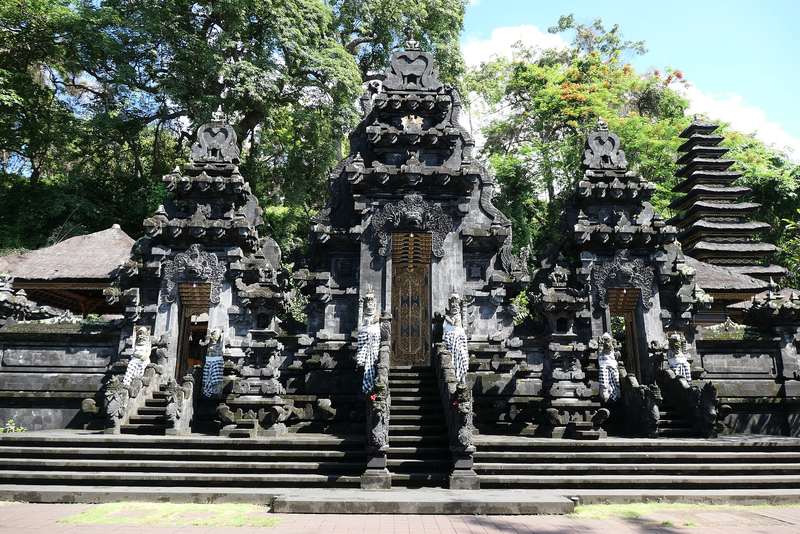
Tradition credits the priest Mpu Kuturan with founding this coastal temple in the 11th century, and it ranks among the holiest on the island. Its shrines stand at the mouth of a cave whose ceiling is packed with nectar bats. In 1849 it lay on the front line when Klungkung fought Dutch troops at nearby Kusamba. The cave itself is sacred and closed to visitors, who watch from the courtyard.

Tip: A small entry fee applies and a sarong is required. It fits neatly on the way to Padang Bai or the airport.

14 · Temple

Pura Bukit Tageh

📍 Banjar Nagi Road, Sangkan Gunung, about 4 km south-west of the market

On a wooded hill above Sangkan Gunung stands a small village temple, shown on maps as both Pura Bukit Tageh and Pura Bukit Sangkan Gunung. A steep staircase leads up from the village in about ten minutes. Most visitors come for the climb itself and the view across the terraces rather than for the shrines. Go early or late in the day, when the light over the valley is softest.

Tip: Bring a sarong and sash, and keep out of the inner courtyard while people are praying.

Tirta Gangga and Lempuyang
Photo by @marimalz

15 · Temple

Tirta Gangga and Lempuyang

📍 Ababi and the slopes of Mount Lempuyang, 28–37 km east (45–75 min)

Together, these two famous sights make a long day out. Tirta Gangga is a water garden started by the last raja of Karangasem in 1946, with koi ponds, stepping stones and spring-fed pools. Lempuyang's split gate, framing Agung behind it, is one of the most photographed views in Bali, but the queue for a turn of less than a minute at the gate often runs two to four hours.

Tip: Entry to Tirta Gangga has been IDR 90,000 since March 2025. Lempuyang charges about IDR 100,000, with IDR 50,000 more for the shuttle.

Itinerary

How to spend your days in Sidemen

Sidemen in a day

A walking day from Tabola Road, about 10 km on foot in total. Only the afternoon trip to Gembleng Waterfall, roughly 10 km each way, needs a scooter or driver.

  1. 6:00

    Watch the first light reach Mount Agung from Tabola Road.

  2. 7:00

    Walk north for about 30 minutes (2.3 km) to Pasar Sidemen while trading is at its busiest.

  3. 8:00

    Continue 250 metres along the main road to Pelangi Traditional Weaving to watch endek being woven.

  4. 9:00

    A 25-minute walk takes you to the booth on the Sangkan Gunung road. Do the 3 km terrace loop, about an hour plus a coffee break.

  5. 11:30

    Walk back to Tabola Road, around 40 minutes, for lunch and a rest through the hottest hours.

  6. 15:00

    Take a scooter or car to Gembleng Waterfall, 20–25 minutes away, and climb its 140 steps from the lower parking area.

  7. 17:30

    Watch the sun drop behind the paddies, then eat within walking distance.

Three days in Sidemen

Walking first, then the river and the village crafts, then a driver for the great temple and the old royal capital.

  1. Day 1

    Use the one-day walking plan.

  2. Day 2, 8:00

    Rafting on the Telaga Waja: the put-in at Menanga is 20 minutes up the road, and lunch is usually part of the package. Afterwards, try a silver-ring class.

  3. Day 2, 16:30

    Ride ten minutes north-east to Iseh for the low evening light on the terraces Spies painted.

  4. Day 3, 7:00

    Drive 30–45 minutes to Besakih and reach the ticket office before the tour groups.

  5. Day 3, 10:30

    Continue 30–40 minutes south to Semarapura: see Kertha Gosa, then browse the textile market.

  6. Day 3, 13:30

    Eat in Semarapura before cooling off at the Tukad Unda weir, about 3 km off.

  7. Day 3, 15:30

    Head east to Goa Lawah, roughly 10 km, before the 30-minute drive back to the valley.

Sidemen on a rainy day

Wet-season storms tend to arrive after lunch, so walk early and keep the afternoon for covered places. A driver is worth it on slippery roads.

  1. 6:30

    Walk the terrace loop while the morning is usually still dry, in closed shoes and long socks against leeches.

  2. 8:30

    Spend an hour under cover at Pelangi Traditional Weaving watching the looms.

  3. 10:00

    Join a guesthouse cooking class and eat what you make for lunch.

  4. 14:00

    Drive 20–30 minutes south to Semarapura for Kertha Gosa's painted ceiling and the covered textile market; the court closes at 5 pm.

  5. 16:30

    Back in the valley, make a silver ring at a workshop near the yellow bridge.

  6. 19:00

    Dinner at your hotel; many valley restaurants close early and the lanes are dark and slippery.

Longer trip? Plan up to seven days from Sidemen or browse our Bali itineraries.

Where to stay

Hotels and villas in Sidemen

All stays in Sidemen →

Seasons

Best time to visit Sidemen

Expect more green, more cloud and cooler air than on the coast. Between roughly May and September the mornings tend to be clear, the field paths stay dry and Mount Agung usually appears at sunrise, while nights from July to September can dip to around 18°C. The wet season runs from October to April, bringing short, heavy afternoon storms, valley mist, muddy paths, leeches and a fuller Telaga Waja for rafting.

July, August and the end of December are the busiest weeks, and the best-known villas fill well ahead. April to June and September offer a good balance of weather and quiet, and rates are lowest in the wet season.

Around Galungan (13 January and 11 August 2027) every village road is lined with penjor, tall arching bamboo poles, until Kuningan ten days on. On Nyepi, 8 March 2027, the island shuts down from 6 am for a full day: no one goes out, and hotels ask guests to stay on the property.

Getting there

How to get to Sidemen

  • Ngurah Rai airport (DPS)1.5 to 2 hours

    About 55–60 km by car along the coastal bypass to Klungkung, then 12 km north into the valley.

  • Ubud1 to 1.5 hours

    About 35 km by car or scooter through Klungkung.

  • Sanur1 to 1.5 hours

    About 40 km by car on the coastal bypass.

  • Seminyak or Canggu1.75 to 2.5 hours

    About 50–60 km by car; set off early to get through South Bali's traffic.

  • Candidasa or Padang Bai40 to 60 minutes

    About 22–25 km by car along the coast road past Goa Lawah.

  • Amed1.25 to 1.5 hours

    Roughly 44 km; drive or ride.

  • Nusa Penida1 to 1.5 hours

    Fast boat from Sampalan to Kusamba in 20–30 minutes, then about 17 km by car.

  • Kintamani1 to 1.5 hours

    About 37 km by car on winding mountain roads.

Getting around Sidemen

The valley stretches over several kilometres of road, so you need transport. Ride-hailing pickups are rare, there are no metered taxis and no dependable buses. Most visitors hire a car with driver for day trips or rent a scooter, and many hotels on Tabola Road lend bicycles or run a shuttle.

Roads are narrow, steep, twisting and slippery after rain. Rent a scooter of at least 155cc, avoid riding at night if you are inexperienced, and set map apps to car mode, because the shortest lanes can be too steep. Within the village and along Tabola Road, walking works well.

Know before you go

Sidemen tips that save time

  1. 01Bring cash from Ubud, Sanur or the airport. Valley ATMs empty or go offline, and warungs, trail fees and waterfall donations are cash only.
  2. 02Before booking, check how your villa is reached; some sit on lanes no car can use.
  3. 03Leeches come out after rain, so walk the paddies in closed shoes and long socks, and pack repellent and a rain jacket.
  4. 04Carry a head torch for walking home after dark and for power cuts; on 2 May 2025 around 80 percent of Bali was without electricity for hours.
  5. 05Plan walks and photos for the early morning, before cloud covers Agung and the heat builds.
  6. 06Pay Bali's IDR 150,000 tourist levy online through the official Love Bali portal before you travel.
  7. 07Climbing Agung needs a licensed local guide, compulsory since January 2025; climbs are cancelled in bad weather and during major ceremonies.
  8. 08Book rafting and cooking classes a day ahead so operators can arrange pickups from your hotel.

FAQ

Sidemen questions, answered

Is Sidemen worth a visit?

+

Yes, if quiet terrace walks, close views of Mount Agung and village crafts appeal more than a list of sights and an evening scene. Give it two or three slow days to get the most from it. As a quick stop from the south it makes less sense, because the drive takes 1.5 to 2 hours each way and you miss the valley's best hours.

Should I choose Sidemen or Ubud?

+

They suit different trips. Ubud has dance, museums, yoga, cafés and easy app rides, along with crowds and traffic. Sidemen has few restaurants and no nightlife, but calmer terraces, nearer views of Agung and weaving in people's homes. Plenty of travellers split their nights between the two, which are only 1 to 1.5 hours apart by car.

How many nights do I need?

+

Two or three. One day covers the terrace loop, the market, the looms and Gembleng Waterfall. A second adds rafting on the Telaga Waja or a cooking class. A third works well for Besakih and Klungkung with a driver. The valley is at its finest at sunrise, so sleeping here rather than visiting for the day makes a real difference.

What is the best way to get from the airport?

+

By car: about 55 to 60 km, taking 1.5 to 2 hours on the coastal bypass to Klungkung and then 12 km north into the valley. Most visitors ask their hotel to arrange a driver. An app ride can bring you in, but drivers rarely collect in the valley, so arrange your onward transport before you leave.

Which area of Sidemen should I stay in?

+

Tabola Road in Telaga Tawang suits most people, with rooms facing the paddies and a few restaurants within walking distance. Stay near the market for guesthouses beside the looms and silver workshops. Iseh and Selat to the north have secluded bamboo villas where you will mostly eat in, so pick one with a good kitchen.

Can I walk the terraces on my own?

+

Yes. Pay IDR 25,000 at the roadside booth on the Sangkan Gunung road and follow the signposted loop of about 3 km; it takes a little over an hour. Off that route, paths cross private fields and irrigation channels, so hire a village guide for longer walks; it is also the best way to learn how the subak water system works.

Do ride-hailing apps work in Sidemen?

+

Only for drop-offs, and even those are unreliable. Few drivers live in the valley, so pickups rarely happen, particularly from villas off the main road or from Gembleng Waterfall. For day trips, hire a car with driver through your hotel, or rent a scooter if you are a confident rider on steep, narrow lanes.

Does Sidemen work as a day trip from Ubud?

+

It can, but the valley is at its best at dawn and dusk, and with 1 to 1.5 hours on the road in each direction you will miss both. With only a day, set off from Ubud at 7 am, do the terrace loop, see the weavers and head back by mid-afternoon.

Is it possible to climb Mount Agung from Sidemen?

+

Yes, but only with a licensed local guide, a rule in force since January 2025. Starting from Pura Pasar Agung above Selat, a shorter climb of 5 to 8 hours there and back ends below the true summit. The route from Besakih reaches the top and takes 10 to 14 hours. Climbs are called off in bad weather and during major ceremonies.

Nearby

Where to go after Sidemen

Read next

More Sidemen guides on the Blog