
Lovina · Nature
Sekumpul Waterfall, North Bali
A whole valley of falls in Sawan, a long staircase down and a guided wade along the river.
By the Baligasm editors · Updated 29 October 2026 · Photo by @tukris_
Overview
Sekumpul Waterfall: before you go
In the Sawan hills of north Bali, Sekumpul gathers six or seven waterfalls into a single jungle valley. Lovina is 28 km away, Ubud a drive of 2 to 3 hours. A viewpoint ticket costs about IDR 20,000; reaching the base means a guided trek from IDR 125,000. Allow two to four hours on site. It rewards anyone fit enough for a few hundred steep steps, and makes most sense from a night in Lovina or Munduk.
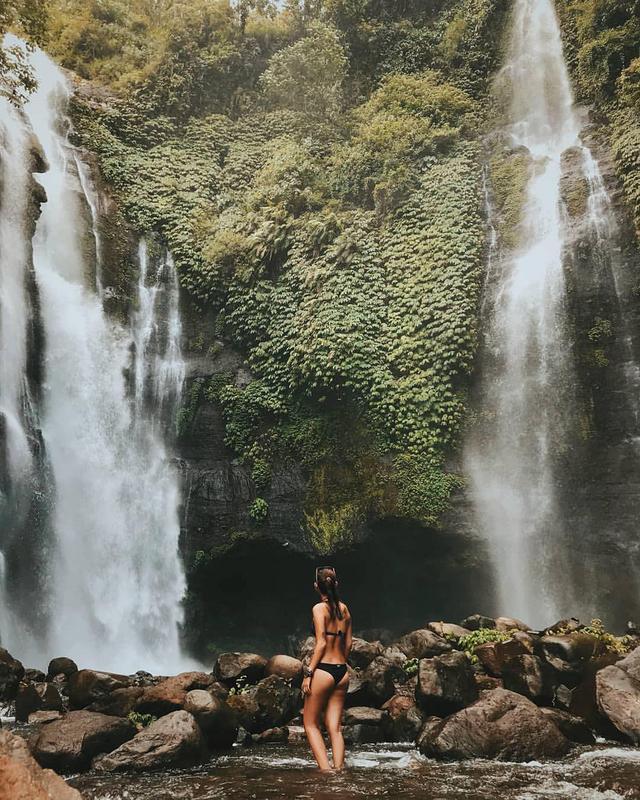
The name means 'a cluster' in Indonesian, and the valley earns it. Six or seven falls spill into one steep gorge hung with ferns, on the boundary between Sekumpul and Lemukih villages, roughly 20 km south-east of Singaraja. The pair that appears in most photos tumbles side by side down a single cliff. Their height is usually put at about 80 metres, though figures as high as 130 metres circulate and nobody has published an official measurement. A river feeds one of the two, so it turns brown after rain; the other rises from a spring and runs clear.
A few hundred metres to the south-west, on Lemukih land, three more falls drop next to each other. Visitors know them as Fiji, while the provincial tourism office lists them as Lemukih's triple waterfall. The village manages the whole site and sells three tickets at its counter next to the 'Welcome to Sekumpul' sign. The cheapest, about IDR 20,000 for foreigners, covers the walk to the rim. The medium trek, IDR 125,000–150,000, descends to the main pair and the Hidden Waterfall, and Fiji is added on the long trek for IDR 200,000–250,000. A village guide comes with either trek, and anyone going beyond the viewpoint is expected to have one.
Be ready for roadside posts. In November 2023 a widely shared video showed cars being stopped on the approach and visitors facing demands of Rp 600,000 for each foreign passenger and Rp 300,000 for each Indonesian. Officials acted on 16 November, when Buleleng's tourism office and the regency's public-order police, Satpol PP, shut four unofficial counters in Pegayaman and Lemukih. Some posts have since reappeared, waving 'registration' banners at drivers well before the village. Do not stop; the only valid ticket is sold in the village itself.
The real effort is physical. After a hilly 20 to 30-minute walk from the counter to the rim, a few hundred concrete steps descend the valley wall, followed by at least two stream crossings at the bottom. Climbing out takes 30 to 40 minutes in heavy, humid air, and that is what most people remember. Skip the descent with bad knees, limited mobility or small children. Coming from the south means five to six hours on the road there and back, which is why many travellers sleep in Lovina or Munduk and arrive early.
- Opening hours
- About 8 am to 5 pm daily; no official timetable is published
- Ticket
- Viewpoint about IDR 20,000; guided treks IDR 125,000–250,000
- Time needed
- One hour for the rim; 2–4 hours to the falls; 4–5 with Fiji
- Best time
- 8 am on a dry-season day; March and April for the strongest flow
- Dress code
- Swimwear under quick-drying clothes; shoes that grip when wet
- Location
- Sawan, Buleleng; a 45–60 minute drive from Lovina
Sekumpul, Sawan, Buleleng Regency, Bali 81171, Indonesia
Open in Google Maps ↗Read it on the Blog →What to see
What to see at Sekumpul Waterfall
The rim viewpoint
With the cheapest ticket you follow a paved lane through the village for 20 to 30 minutes to a platform overlooking the gorge. From here you can see Sekumpul's main pair and, when the air is clear, the three Fiji falls beside them; it is the only spot where the whole group fits in one view. It suits visitors short on time or energy, and it is the place for drones, because GPS drops out at the bottom.
The staircase into the valley
Depending on the route and who did the counting, there are somewhere between 320 and 365 concrete steps. They are steep and uneven, and spray makes the lower flights wet. Small warungs along the way sell cold drinks and snacks. Go down slowly to spare your knees, and keep some water back for the return: 30 to 40 minutes of continuous climbing, and the toughest part of the visit.
The foot of the main falls
You feel the spray well before you reach the water, and the gusts coming off the falls soak clothing within minutes. Sekumpul's two big falls land next to each other, and after rain the river-fed one runs muddy while its spring-fed twin stays clear. A low river means you can wade into the pool beneath them, or even swim. Stay clear of the churning water directly under the falls, and check with your guide before getting in.
The Hidden Waterfall
Both guided treks include this fall, set in a slim side gorge a short way from the main pair. The guide takes you through palms and drooping ferns, and the final section is a wade upstream. Its pool is large enough for a paddle and normally calmer than the main falls, since people with a viewpoint ticket never get this far.
Fiji, the triple fall
The long trek continues to the three side-by-side falls called Fiji, on the Lemukih side of the valley. The walk from the main pair takes anywhere from 10 to 30 minutes, with more river crossings and stretches of muddy, unpaved ground. The drops are lower than Sekumpul's, but the clear, shallow pools at their base often make the best swim in the valley.
River crossings on the valley floor
A narrow bridge spans the river at the foot of the stairs, and past it the routes to the falls ford at least two streams. The water can come above the knee, and it climbs and speeds up after rain. Guides lend a hand on the slippery rocks. Strap-on shoes or sandals with grip are essential; flip-flops are not. Carry phones and cameras in a waterproof bag.
Lemukih terraces and rock-slide treks
Lemukih, across the valley, has terraced paddies a few kilometres from Sekumpul and runs its own guided outings. Some operators sell five-hour treks that cross the terraces and forest, include a natural rock slide and finish at Sekumpul and Fiji, with helmets and water shoes supplied. Book these in advance with an established operator, never at a post by the road.
Seasons
Best time to visit Sekumpul Waterfall
Be at the counter when it opens, at about 8 am. Day tours from Ubud and the south only get here from mid-morning after a drive of at least two and a half hours, and crowds can be building by 9 am. Starting early also means you are back at the top before the midday heat and before the afternoon storms that roll over the hills between December and March.
Flow peaks from January to April, and March and April, as the rains ease, combine full falls with fewer storms. During the wet season, roughly November to March, the river-fed fall runs brown, the crossings become deeper and quicker and the stairs never dry; flash floods occasionally cut access. There is no published closure calendar, so watch the forecast, ask at the counter and stick to the viewpoint if the river is up. May to September brings thinner falls but drier paths.
Expect more domestic visitors at weekends and on public holidays. The island stops completely for Nyepi on Monday 8 March 2027, with no travel allowed. Galungan, which falls on 13 January and 11 August 2027, fills the village lanes with temple processions.
Getting there
How to get to Sekumpul Waterfall
Lovina (Kalibukbuk)45–60 minutes
About 28 km east through Singaraja, then inland via Menyali. The final section is steep and narrow, so go by scooter or with a driver.
Singaraja30–45 minutes
About 20 km: follow the Amlapura road east, then head inland via Menyali.
MundukAbout 1 hour
Roughly 30 km: head east to Wanagiri, then descend through Pegayaman. Banyumala and the twin-lakes viewpoint lie along the way.
Ubud2–3 hours
About 65 km north by car via Bedugul, leaving the main road after Wanagiri. Set off by 6 am to beat the crowds; a car with driver costs about IDR 700,000–900,000 for the day.
Seminyak or Canggu2.5–3.5 hours
About 72–81 km through Mengwi and Bedugul, with Denpasar traffic deciding the timing. Ulun Danu Beratan or Handara Gate make an easy stop on the way home.
Ngurah Rai airport (DPS)2.5–3.5 hours
Around 85 km through Denpasar and the Bedugul highlands. It will not fit into the day you land; base yourself in Lovina or Munduk first.
| From | Time | How |
|---|---|---|
| Lovina (Kalibukbuk) | 45–60 minutes | About 28 km east through Singaraja, then inland via Menyali. The final section is steep and narrow, so go by scooter or with a driver. |
| Singaraja | 30–45 minutes | About 20 km: follow the Amlapura road east, then head inland via Menyali. |
| Munduk | About 1 hour | Roughly 30 km: head east to Wanagiri, then descend through Pegayaman. Banyumala and the twin-lakes viewpoint lie along the way. |
| Ubud | 2–3 hours | About 65 km north by car via Bedugul, leaving the main road after Wanagiri. Set off by 6 am to beat the crowds; a car with driver costs about IDR 700,000–900,000 for the day. |
| Seminyak or Canggu | 2.5–3.5 hours | About 72–81 km through Mengwi and Bedugul, with Denpasar traffic deciding the timing. Ulun Danu Beratan or Handara Gate make an easy stop on the way home. |
| Ngurah Rai airport (DPS) | 2.5–3.5 hours | Around 85 km through Denpasar and the Bedugul highlands. It will not fit into the day you land; base yourself in Lovina or Munduk first. |
Know before you go
Tips for your visit
- 01Drive straight past any 'registration' post on the approach and park at the official car park beside the 'Welcome to Sekumpul' sign, next to the ticket counter. Ask for a printed ticket.
- 02Parking costs a car about IDR 5,000 and a scooter IDR 2,000. Riders can carry on some 800 metres down the lane to a last parking area where the paved road ends.
- 03Your guide is allocated at the counter and walks with you the whole time. Before paying, confirm which falls are included, especially whether the Fiji leg is part of the long trek.
- 04The guide fee is the same whether your guide walks beside you or lags behind, so say clearly if you want a hand on the stairs and rocks.
- 05Bring small notes for the ticket, parking and the warungs on the stairs.
- 06Wear swimwear under quick-drying clothes and pack a towel and a change of clothes; the spray drenches everyone.
- 07There is nowhere to leave belongings at the bottom, so carry valuables in a dry bag.
- 08Refill a bottle rather than taking the plastic one handed out on the long trek.
- 09Launch drones from the rim, not the valley floor; retrieving a crashed drone from the gorge can cost around IDR 400,000.
- 10Never ford a stream that is brown and fast-flowing. Wait, or turn back with your guide.
- 11Insect repellent helps in the humid valley, and allow at least 45 minutes for the climb back up.
- 12Ride-hailing cars and bikes are rare up here and you will not get one back from the village, so keep your driver or agree a pickup time. On a scooter, rent at least 150cc for the steep lanes.
FAQ
Sekumpul Waterfall questions, answered
How much does it cost to visit Sekumpul?
+
Foreigners pay about IDR 20,000 to walk to the viewpoint. The medium guided trek, down to Sekumpul's base and the Hidden Waterfall, costs IDR 125,000–150,000, and the long trek that adds the Fiji falls costs IDR 200,000–250,000, guide included. Indonesian visitors pay around IDR 10,000 for the viewpoint. Buy only at the village's own counter.
Is a guide compulsory?
+
To reach the falls, effectively yes. Both treks that go down to the falls are sold only with a village guide, and visitors who go past the viewpoint are expected to have a guide. In 2023 Buleleng's tourism chief said higher-risk sites like this one require a guide, though no written village rule has been published. The viewpoint ticket alone needs no guide.
How many steps lead down to the falls?
+
Somewhere between 320 and 365 concrete steps, depending on the route, after a hilly 20 to 30-minute walk through the village. Allow 30 to 45 minutes between the car park and the valley floor. The return climb, 30 to 40 minutes of steady stairs, is the hardest part, so it is a poor choice for anyone with knee trouble or reduced mobility.
What are the Fiji falls?
+
Fiji is the local name for three waterfalls that fall next to each other in the same valley as Sekumpul, a few hundred metres south-west on the Lemukih side. Bali's provincial tourism office calls them Lemukih's triple waterfall. They are visible from the Sekumpul viewpoint, and the long guided trek, about IDR 200,000–250,000, takes you down to their pools.
How long does a visit take?
+
The viewpoint on its own needs about an hour. Going down to the main pair and the Hidden Waterfall takes two to four hours, and including Fiji stretches it to four or five. Leave room for a swim and a cold drink on the climb out. Add five to six hours of driving if you come from Ubud or the south, which turns it into a full day.
Can I swim at Sekumpul?
+
Yes, when the river is low. The pool beneath the main falls is fine for a wade or a short swim, though the spray and wind make it hard to linger, and the Hidden Waterfall and Fiji have calmer pools. Avoid the churn right under any fall, ask your guide first and stay out when the river is brown and fast.
How far is it from Ubud?
+
About 65 km. By car via Bedugul that is 2 to 3 hours in each direction, so aim to be on the road at 6 am and at the counter before the tour groups, and expect a day of 10 hours or more. Drivers often stop at Ulun Danu Beratan, Handara Gate or Banyumala on the way back. A night in Lovina or Munduk makes the visit far easier.
Is Sekumpul worth the effort?
+
Yes, if the stairs and the drive are manageable for you. Nowhere else in Bali gathers this many tall falls in a single valley, and the guided walk along the river floor feels like a proper outing rather than a quick photo stop. From the south it takes a full day, so it works best from Lovina or Munduk, or paired with the Bedugul lakes.
Is it safe to go in the rainy season?
+
It can be, with care, but conditions change quickly. Between November and March the stairs and rocks stay slippery, the river-fed fall turns brown and the stream crossings become deeper and faster, and flash floods occasionally block access. No closure calendar exists. Go early, check the forecast and turn back with your guide if the water is high.
How tall is Sekumpul?
+
The figure most often given is about 80 metres, although heights up to 130 metres are quoted and the falls have never been officially measured. Both main falls leave the same cliff edge together, and the valley walls around them climb higher still. What really sets Sekumpul apart is not the height but how many falls share one valley.
How do I avoid being overcharged on the way in?
+
Ignore anyone flagging cars down for 'registration' on the approach roads, and pay only at the official counter beside the 'Welcome to Sekumpul' sign in the village. In 2023 unofficial posts in Pegayaman and Lemukih demanded Rp 600,000 from foreigners; officials shut four of them, but some have returned. Always ask for a printed ticket.
Nearby
Pair it with
Gitgit Waterfall
A 35 to 40-metre fall about 500 metres on foot from the Bedugul to Singaraja road, for tired legs; 35–45 minutes by car.
Aling-Aling and Kroya
Guided rock slides and cliff jumps in Sambangan, below a sacred 35-metre fall; 45–60 minutes by car.
Banyumala Twin Waterfalls
Two side-by-side falls near Wanagiri with the finest swimming hole in the highlands, on the route south; 45–60 minutes by car.
Pura Beji Sangsit and Jagaraga
Richly carved north-coast temples with Dutchmen, cars and aeroplanes in the reliefs; 20–30 minutes by car.
Ulun Danu Beratan
Bedugul's lakeside temple, a natural break on the road back to Ubud or the southern beaches; 40–50 minutes by car.