
Bedugul · Temple
Pura Ulun Danu Beratan, Bedugul
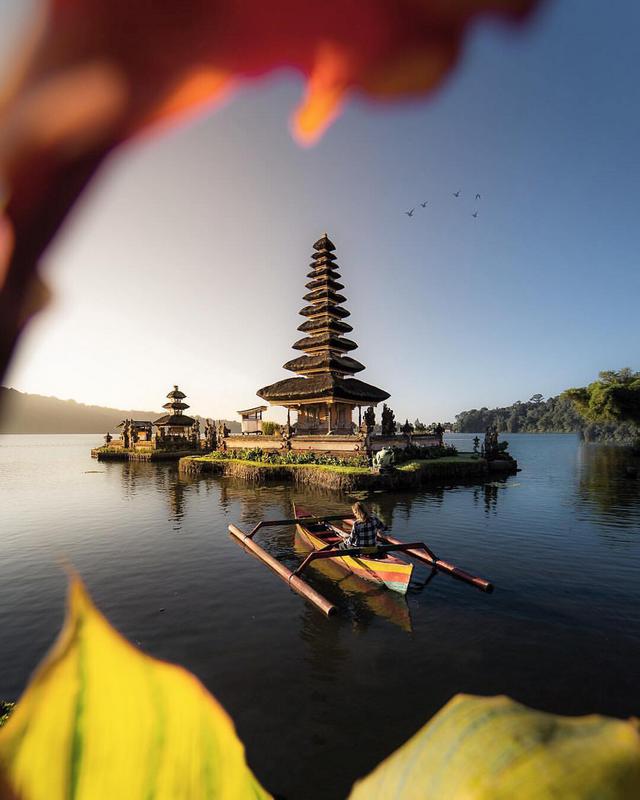
The lake goddess's temple on Lake Beratan, calm and misty at 7 am, crowded and cloudy by noon.
By the Baligasm editors · Updated 29 October 2026 · Photo by @harry.travel
Overview
Pura Ulun Danu Beratan: before you go
Pura Ulun Danu Beratan is a 17th-century Hindu water temple on the western shore of Lake Beratan in Bedugul, about 64 km and 1.75 to 2.5 hours by car from the airport, or 1.5 to 2 hours from Ubud and Canggu. Its tiered shrines stand on islets in the lake. Foreign adults pay IDR 100,000. Allow one to two hours, ideally at the 7 am opening; it suits first-time visitors, families and photographers.
The temple belongs to Dewi Danu, goddess of the lake. Lake Beratan, roughly 1,200 m up in the old Bratan caldera, feeds springs and rivers that irrigate rice land across central Bali, and the subak, the farmers' water-sharing associations, pray here for a reliable flow. The Babad Mengwi chronicle places its founding in 1634 (many accounts say 1633) under I Gusti Agung Putu, the Mengwi ruler who built Pura Taman Ayun in the same year. Tour sellers often claim UNESCO status, but the lake temple in Bali's World Heritage listing is Ulun Danu Batur at Kintamani, not this one.
The famous view is of two shrines on tiny islets a few metres off the shore. The larger is an 11-tier meru, generally said to honour Shiva together with Parvati, a goddess frequently equated with Dewi Danu; beside it is a three-tier companion. With the lake high, water surrounds both and they appear to float. When the level falls, stone footings and shallows appear and the illusion fades. Bank Indonesia printed the scene on the reverse of its 50,000-rupiah note from 2005; the current design carries a Legong dancer and Komodo instead.
Go in with the right expectations. This is an active temple run as a ticketed visitor park, with lawns, a koi pond, a playground, costume hire and a boat jetty wrapped around the sacred courtyards. Visitors wander the gardens and the shoreline, but the shrines are for worshippers. A typical day sees 500 to 800 people; long weekends exceed 2,000, and about 4,000 came on Umanis Galungan, the day after Galungan, in November 2025. Coaches start arriving mid-morning and cloud often drifts off the hills before noon, so aim for 7 am.
A few things are new. On 1 July 2026 foreign tickets rose to IDR 100,000 for adults and IDR 75,000 for children, from IDR 75,000 and IDR 50,000, and the weekday and weekend split was dropped; part of the revenue goes to the surrounding customary villages. Since 2022, a daily gebogan procession, a line of women with tall fruit offerings balanced on their heads, has crossed the lakeshore in the high season, free to watch, and in 2026 it ran from 21 June to 9 August. Arrive early, take a boat, and the long drive pays off.
- Opening hours
- 7 am to 7 pm every day; ceremonies can close sections briefly
- Ticket
- Foreign adults IDR 100,000, foreign children IDR 75,000
- Time needed
- 1 to 1.5 hours; around 2 with a boat ride
- Best time
- 7–9 am, before fog, wind and coaches; April to October
- Dress code
- Cover shoulders and knees; a temple sash is handed out at the entrance
- Location
- Western shore of Lake Beratan, Candikuning; 1.5–2 hours from Ubud
Danau Beratan, Candikuning, Baturiti, Tabanan, Bali 82191
Open in Google Maps ↗Read it on the Blog →What to see
What to see at Pura Ulun Danu Beratan
The shrines on the lake
Two islets just off the shore carry the 11-tier meru and a smaller three-tier shrine. The postcard angle comes from the shoreline path beside them, looking across the water to the wooded flanks of Gunung Catur. Until about 9 am the surface is often still enough for a clean reflection; wind and cloud usually break it up later in the morning. Keep to the path, because the platforms are sacred and the lake is closed to swimmers.
Pura Penataran Agung and the inland courtyards
Away from the water, a candi bentar split gate leads towards Pura Penataran Agung, where Dewi Danu is venerated as ruler of the lake. Smaller temples surround it: Pura Dalem Purwa for Durga, Pura Taman Beji beside a purification spring used for melasti rites, and Pura Prajapati beneath a big banyan. Non-Hindus view them from outside the walls, and on prayer days from a respectful distance.
The Buddhist stupa
By the entrance, outside the main Hindu enclosure, stands a south-facing Buddhist stupa. It reflects the long blending of Hindu and Buddhist practice on Bali, and Buddhist visitors still pray there. Add Masjid Al-Hidayah, Bedugul's large mosque on the hill a few hundred metres behind, and three faiths share one short stretch of lake and slope.
A boat ride for the best view
The jetty inside the grounds rents boats, and half an hour on the lake shows the meru from the angle most people miss. On the December 2024 price board, pedal boats were the cheapest at IDR 40,000, a wooden rowing boat cost IDR 75,000, the duck-shaped boats IDR 90,000 and a fast speedboat circuit IDR 200,000; by 2026 a jukung was going for IDR 75,000–100,000. Go before the wind rises, and settle the price first.
Gardens, koi and optional extras
Lawns and flower beds fill the space between the shrines, alongside a koi pond (about IDR 10,000 for fish food), a playground and stalls that dress visitors in full Balinese costume for photos, roughly IDR 90,000–150,000 a person in August 2026. Other stalls charge IDR 25,000–50,000 to pose with caged birds and animals; give those a miss. None of it is necessary, and the lake view is included in the ticket.
Ceremonies, processions and dance
Worship continues around the visitors. Families arrive with offerings on full and new moon days and around Galungan; some 4,000 people came on Umanis Galungan in November 2025. In the high season, the free daily gebogan procession of women balancing fruit towers has run since 2022, starting around 12:30 pm in 2025. Dance groups from the 20 banjar of Candikuning take turns on stage during the Christmas and New Year holidays.
Seasons
Best time to visit Pura Ulun Danu Beratan
Be at the gate when it opens at 7 am and stay until around 9. The lake tends to be flat, mist often lingers on the surface and coaches from the south are still on the road. By late morning the wind ripples the water, cloud slides off the hills and buses pack the parking area; photos suffer most between 11 am and 3 pm. From about 3:30 pm, crowds thin again ahead of the 7 pm close.
April to October gives the clearest mornings. July and August are the driest months and also the busiest; July 2025 was the temple's peak month that year, with about 51,000 visitors. Between November and March, rain often starts by early afternoon, though the lake runs higher in the wet season, which strengthens the floating effect. After a long dry spell the level can drop noticeably. Nights fall to 10–15°C in every season.
Crowd levels track the Indonesian calendar. Expect 500 to 800 people on an ordinary day, about 2,200 a day over a May 2026 long weekend and roughly 4,000 on Umanis Galungan in November 2025. Galungan next falls on 13 January and 11 August 2027, with Umanis Galungan on the following day each time, and Christmas to New Year is also busy. Nyepi, on 8 March 2027, closes the whole island for 24 hours, the airport included.
Getting there
How to get to Pura Ulun Danu Beratan
Central Ubud1.5–2 hours
Around 45 km. Your driver takes the main road north towards Singaraja and up through Baturiti; a 6:30 am start gets you there close to 8.
Canggu1.5–2 hours
Roughly 54 km through Mengwi and Baturiti, with Pura Taman Ayun in Mengwi a natural break on the way.
Seminyak1.75–2.5 hours
Around 55–60 km north via Mengwi; set off before 7 am to get ahead of Denpasar traffic.
Ngurah Rai airport (DPS)1.75–2.5 hours
About 64 km in a pre-booked car through Denpasar and Baturiti. Afternoon traffic out of Denpasar makes this a poor arrival-day trip; fit it into a journey north instead.
Munduk30–40 minutes
Roughly 20 km by car or scooter along the Wanagiri ridge and down through Pancasari, past the twin-lakes viewpoint.
Jatiluwih (Tabanan)45–60 minutes
About 25 km by road through Baturiti, so the terraces and the lake combine into one cool day.
Lovina1–1.5 hours
Around 38 km south over the pass via Gitgit, which puts the temple on any drive between the north and south coasts.
| From | Time | How |
|---|---|---|
| Central Ubud | 1.5–2 hours | Around 45 km. Your driver takes the main road north towards Singaraja and up through Baturiti; a 6:30 am start gets you there close to 8. |
| Canggu | 1.5–2 hours | Roughly 54 km through Mengwi and Baturiti, with Pura Taman Ayun in Mengwi a natural break on the way. |
| Seminyak | 1.75–2.5 hours | Around 55–60 km north via Mengwi; set off before 7 am to get ahead of Denpasar traffic. |
| Ngurah Rai airport (DPS) | 1.75–2.5 hours | About 64 km in a pre-booked car through Denpasar and Baturiti. Afternoon traffic out of Denpasar makes this a poor arrival-day trip; fit it into a journey north instead. |
| Munduk | 30–40 minutes | Roughly 20 km by car or scooter along the Wanagiri ridge and down through Pancasari, past the twin-lakes viewpoint. |
| Jatiluwih (Tabanan) | 45–60 minutes | About 25 km by road through Baturiti, so the terraces and the lake combine into one cool day. |
| Lovina | 1–1.5 hours | Around 38 km south over the pass via Gitgit, which puts the temple on any drive between the north and south coasts. |
Know before you go
Tips for your visit
- 01Arrive for the 7 am opening: the water is at its calmest and the tour coaches turn up from mid-morning.
- 02Many websites still quote the old IDR 75,000; the temple posts price changes on its own Instagram account, @_ulundanuberatan_.
- 03Bring a fleece and a rain jacket. Mornings at about 1,200 m are cool, nights drop to 10–15°C and cloud or rain can roll in during any month.
- 04The ticket desk takes international cards, but parking, boat hire and koi food are cash affairs, so keep small notes.
- 05Agree the price and the length of a boat trip before boarding; a rowing boat gives the quietest drift past the shrines.
- 06Never swim, climb onto the shrine platforms or touch sacred structures, and ask before photographing anyone at prayer.
- 07Balinese custom asks women who are menstruating to stay out of the sacred areas.
- 08Skip the stalls selling photos with caged birds and animals.
- 09If you arrive after lunch, visit the botanic garden first, as it shuts at 4 pm, and leave the lake for the late afternoon.
- 10Book a driver for both directions; app-booked cars will drive you up, yet finding one for the descent is a gamble.
- 11The car park by the entrance charges a few thousand rupiah: about IDR 5,000 per car, less for a scooter and IDR 10,000 for a bus.
FAQ
Pura Ulun Danu Beratan questions, answered
How much is the ticket for foreign visitors?
+
A foreign adult ticket has cost IDR 100,000 since 1 July 2026, and a child IDR 75,000, with one price for every day of the week. Indonesian adults and children pay IDR 50,000 and IDR 25,000, and Bali residents IDR 30,000 and IDR 20,000. Older websites still show IDR 75,000 for foreign adults. Parking, boats and costume hire are extra.
What time does the temple open and close?
+
It is open from 7 am to 7 pm daily, including weekends and public holidays, although ceremonies may close parts of the grounds for a while. The first two hours after opening are best, before the fog, the wind and the coaches. The later afternoon, from about 3:30 pm, is the next-best window.
Is Ulun Danu Beratan worth the drive?
+
Yes, as long as you arrive early and combine it with Candikuning market, the botanic garden or Jatiluwih. At 7 am, with mist on still water and the meru reflected beneath it, the scene earns its fame. Visit at lunchtime on a public holiday, among thousands of others under low cloud, and it can feel more like a theme park than a place of worship.
Does the temple really float on the lake?
+
No. Both meru stand on small islets close to the shore. When the water is high it laps all round them, giving the floating look. When the level falls, usually after a long dry season, the stone bases and shallows show and the shrines seem attached to the bank. A calm early morning adds the mirror reflection.
Are visitors allowed inside the shrines?
+
No. Your ticket opens the lawns, the lakeshore paths and the outer grounds. Courtyard interiors and the island shrines stay closed to all but those coming to pray, though you can peer in over the walls. Dress modestly, put on the sash you are given at the gate and step aside whenever a ceremony is under way.
How do I get there from Ubud, Canggu or Seminyak?
+
With a car and driver. From Ubud it is about 45 km, 1.5 to 2 hours; from Canggu about 54 km over a similar time; and from Seminyak 55 to 60 km, up to 2.5 hours. The airport is about 64 km away. Perama's shared shuttle stops opposite the lake, and ride-hailing works for the trip up but seldom for the return.
Is the temple on the 50,000-rupiah note?
+
It used to be. Bank Indonesia's 2005 series of the 50,000-rupiah note put I Gusti Ngurah Rai, a national hero, on one side and the lake temple, with a canoe and its paddler on the water, on the reverse. The 2016 redesign, retained in 2022, swapped this for a Legong dancer and Komodo National Park, so the notes in circulation today mostly show the newer image.
What do the boats cost?
+
In December 2024 they ranged from IDR 40,000 in a pedal boat up to IDR 200,000 for a spin in a speedboat, with the quiet wooden rowing boats at IDR 75,000. Expect similar or slightly higher rates in 2026, and confirm before boarding. Swimming in the lake is prohibited.
Is the name Bratan or Beratan?
+
Both are used. Beratan is the Indonesian spelling preferred by the temple and local press, while Bratan is the shorter form common in English. Ulun Danu translates loosely as head of the lake. Do not mix it up with Pura Ulun Danu Batur on Lake Batur at Kintamani, a separate temple and the one inside Bali's UNESCO listing.
How much time should I set aside?
+
An hour covers the gardens and the shoreline; allow up to two with a boat ride and a stop at the koi pond. Add a 15-minute walk to Candikuning market and around two hours at the botanic garden, and Bedugul makes a full day trip from Ubud or Canggu.
What should I wear?
+
Clothes covering shoulders and knees, plus the sash handed out at the entrance; sarongs are available if you turn up in shorts. At around 1,200 m fog and showers arrive quickly, so carry a warm layer and a rain jacket, and leave beachwear for the coast.
Nearby
Pair it with
Bali Botanic Garden
Uphill from the temple, a garden of conifers and orchids with a Begonia House and glasshouses full of cacti; weekday entry is IDR 15,500 and the gates shut at 4 pm. About 2 km, 10 minutes by car.
Candikuning market
Strawberries, passion fruit, tamarillos and flowers from the farms around the lake; bargain hard, as every tour stops here. 1.1 km south, about 15 minutes on foot.
Handara Gate
The mossy split gate of the Handara golf resort, now a ticketed photo stop with long late-morning queues. About 3 km north, 5–10 minutes by car.
Jatiluwih Rice Terraces
Tabanan's UNESCO-listed red-rice terraces on the slopes of Mount Batukaru, the natural partner for a highland day. 45–60 minutes by car.
Pura Taman Ayun
The moated royal temple built by the same Mengwi king in 1634, part of the UNESCO subak listing and a good break on the drive up. About 1 hour by car.
More in Bedugul