
Amed · Temple
Pura Lempuyang, East Bali
The island's longest photo queue, and a pilgrim stairway that few visitors attempt.
By the Baligasm editors · Updated 29 October 2026 · Photo by @goralka102
Overview
Pura Lempuyang (Gates of Heaven): before you go
Pura Lempuyang is a string of seven Hindu temples climbing Mount Lempuyang in Karangasem, about 40 minutes by car from Amed. The lowest holds the split gate that frames Mount Agung, known as the Gates of Heaven, where a numbered ticket and a 2 to 4-hour wait are now normal. Go for the first shuttle on a clear morning, or for the long climb to the summit temple.
There are seven temples here, not one, spread up the flanks of Mount Lempuyang (Gamongan to many Balinese) in the Karangasem regency. At the top, around 1,060 m, Pura Lempuyang Luhur counts among Bali's nine directional temples as guardian of the east, and is dedicated to Hyang Gni Jaya, a form of the god Iswara. The complex is thought to go back to the 11th century. Its name is commonly explained as lampu, light, joined to hyang, god.
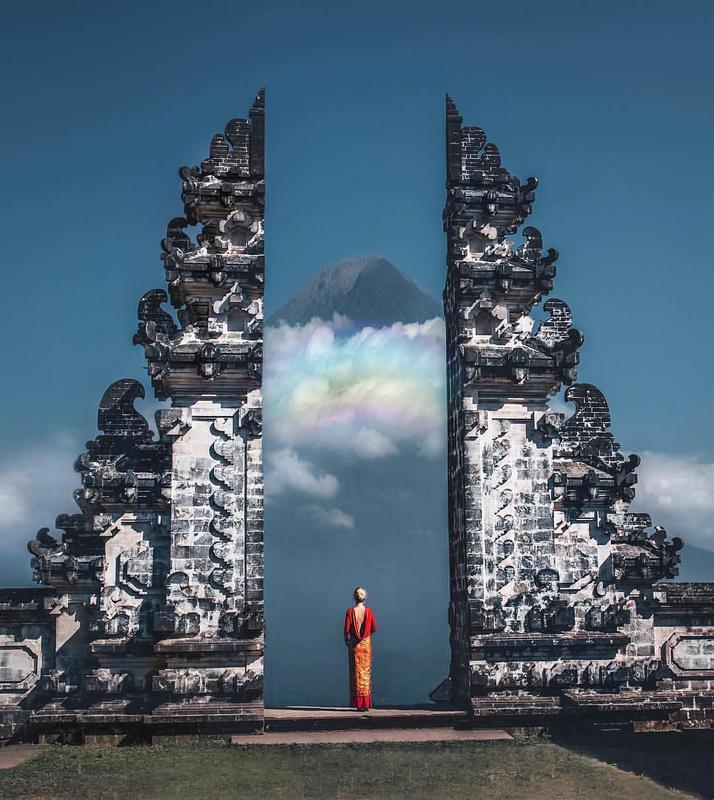
The celebrated gate belongs to the lowest temple, Pura Penataran Agung Lempuyang, at roughly 600 m. In form it is a candi bentar, the divided gateway that opens into most Balinese temples. This one is whitewashed, and through the gap you look 14 km across to Mount Agung. Turn round and three white portals rise above naga-lined stairways towards the inner courtyards; restoration finished in 2001. To worshippers the gate is simply the way into the outer yard. The heavenly name came from visitors.
Fame has reshaped the visit. Entry relied on donations until 2022, when a set fee of IDR 55,000 and a shuttle from a lower car park arrived, and by early 2023 foreigners were paying IDR 100,000. That March, after a group of foreigners tried to get in free with Balinese ID cards, guides made clear that foreign visitors pay even if they come to pray. These days the routine is a car park at the bottom, a minibus up the hill, buy a ticket with a sarong and receive a number. Groups are called by megaphone, and your turn lasts roughly a minute and three poses. On a busy morning, expect 2 to 4 hours in line for it.
Know what you are queuing for. No lake or pool lies in front of the gate; the reflection in the famous photos is produced by a local photographer holding a small mirror under your phone. Agung may not appear either, since cloud often covers it by mid-morning and can hide it all day in the wet season. The bigger reward lies uphill. Some 1,700 steps lead on through the forest, past five lesser shrines, to Lempuyang Luhur at the summit; going up and back takes 3 to 4 hours, in the company of pilgrims and macaques. Few photo-seekers attempt it, and locals ask only that those who do keep their complaints to themselves.
- Opening hours
- Visitors roughly 7 am–5 pm; first shuttle about 5:30 am
- Ticket
- Foreigners IDR 100,000 plus IDR 50,000 shuttle, cash only
- Time needed
- 1–4 hours at the gate, mostly waiting; 3–4 hours more to climb
- Best time
- The first shuttle on a clear morning, April to October
- Dress code
- Sarong and sash come with the ticket; cover your shoulders
- Location
- Mount Lempuyang, 16 km south of Amed (about 40 minutes)
Banjar Purwayu, Tri Buana, Abang, Karangasem Regency, Bali 80852
Open in Google Maps ↗Read it on the Blog →What to see
What to see at Pura Lempuyang (Gates of Heaven)
Queuing for the gate photo
Every ticket carries a number. Staff call them over a megaphone in batches of five or ten; when yours comes up, you give your phone to the resident photographer and step into the gap between the gate's two halves. You have around a minute for three poses. Yoga positions, raised legs and kissing are all banned. The frame looks west to Mount Agung, so keep still and let the volcano carry the picture.
How the mirror trick works
That water-like reflection comes from a small mirror, or occasionally another phone screen, held flat just beneath your lens, so the gate and sky appear doubled along the bottom of the frame. The gate itself stands on dry stone. Photos come free with the ticket, though tipping the photographer IDR 10,000 to 20,000 is usual. Ask for a few frames without the mirror as well; they show the temple as it really looks.
The naga stairways of Penataran Agung
The finest architecture is behind you while you queue. Three white paduraksa gateways crown stairways guarded by naga serpents, lined with figures from the Mahabharata, among them Yudhistira, Bima and Arjuna, while Krishna stands above. You go in on the left and come out on the right; the central door is opened only for the temple festival. Nobody queues here, which makes it the best use of your waiting time.
Mount Agung through the gate
Agung, Bali's highest volcano at 3,031 m, rises around 14 km west-north-west of the gate. Early light falls on its eastern side from over your shoulder, and the lower valleys are often filled with mist. As the morning goes on, cloud tends to swallow the peak. When the queue is huge, try the rear side of the gate: hardly anyone poses there, and the frame works with or without the mountain.
The climb to Pura Lempuyang Luhur
From the gate, a steep lane and then roughly 1,700 steps cover about 2.5 km and nearly 460 m of height to the summit temple. Along the way you pass Telaga Mas, Telaga Sawang, Lempuyang Madya, Puncak Bisbis and Pasar Agung, the smaller temples of the group. Most people need up to two hours on the way up, and half a day is safest for the whole outing. The steps are uneven and slick after rain; wear grippy shoes and carry at least 1.5 litres of water.
Monkeys, stalls and pilgrims
Long-tailed macaques patrol the upper path and grab drinks, snacks, hats and sunglasses, so keep everything zipped away, avoid eating in front of them and never feed them. Stalls selling water, soft drinks and snacks appear at intervals, growing pricier as you climb. Balinese pilgrims, often dressed in white and carrying offerings, share the stairs; let them pass on narrow sections and speak quietly near the shrines.
Pura Lempuyang Luhur at the top
The summit temple, on the hill locals call Bisbis, is dedicated to Hyang Gni Jaya, Iswara in his role as guardian of the east, and Balinese Hindus hold it among their most sacred sites. Treat it as somewhere people pray rather than a lookout, though on clear days climbers can see Agung and, across the strait, Rinjani on Lombok. Village rules ban food containing pork here, and ask women on their period, mourners, nursing mothers and children who still have all their baby teeth not to enter.
Seasons
Best time to visit Pura Lempuyang (Gates of Heaven)
Be at the terminal for the first shuttle, at about 5:30 am. The sun rises around 5:45 am in November and about 6:35 am in July, so the earliest groups at the gate see early light reach Agung. The queue still grows quickly; one visitor arriving at 6 am drew number 84. From about 7 to 11 am, waits of 2 to 4 hours are normal. After about 3 pm the line can shrink to a few people, but by then the mountain is often in cloud.
The dry season, April to October, offers the best odds of a clear Agung, along with the biggest crowds, particularly in July, August and at weekends. Between November and March the queue may be short, sometimes just 15 minutes, but the volcano may never show. Look at the forecast for Karangasem specifically, not for Ubud or the south.
During its pujawali, the temple festival that starts on Galungan, Lempuyang closes to tourists for roughly five days; recent examples were 2 to 6 August 2023 and 23 to 27 April 2025. Galungan next falls on 13 January 2027, so expect a closure from about 13 to 17 January, though the village sets the exact days and lets guides and agents know. Bali's day of silence, Nyepi, keeps everyone at home on 8 March 2027.
Getting there
How to get to Pura Lempuyang (Gates of Heaven)
Amed (Jemeluk)About 40 minutes
Around 16 km by car or scooter via Culik, then uphill to the temple terminal. No base is closer for the first shuttle: set off from Jemeluk by 4:45 am.
Candidasa45–60 minutes
Around 28 km by car through Amlapura. A 4:30 am pickup gets you to the terminal in time for the first shuttle.
Sidemen1–1.25 hours
Around 37 km on rural roads heading east; stop at Tirta Gangga on the return.
Ubud2–2.5 hours
Around 73 km via Klungkung and the east-coast road. Leave at about 3 am for the first shuttle, and expect afternoon traffic to slow the return.
Sanur2–2.5 hours
Take the coast highway (Ida Bagus Mantra) east, then continue through Candidasa and Amlapura; roughly 77 km.
Seminyak or Canggu2.5–3.5 hours
Expect about 87 km and a 3 am departure on sunrise tours; sleeping in Amed or Candidasa the night before is far kinder.
Ngurah Rai airport (DPS)2.5–3 hours
Around 92 km, plus 20–40 minutes from Nusa Dua or Uluwatu. Too far to fit around a flight.
| From | Time | How |
|---|---|---|
| Amed (Jemeluk) | About 40 minutes | Around 16 km by car or scooter via Culik, then uphill to the temple terminal. No base is closer for the first shuttle: set off from Jemeluk by 4:45 am. |
| Candidasa | 45–60 minutes | Around 28 km by car through Amlapura. A 4:30 am pickup gets you to the terminal in time for the first shuttle. |
| Sidemen | 1–1.25 hours | Around 37 km on rural roads heading east; stop at Tirta Gangga on the return. |
| Ubud | 2–2.5 hours | Around 73 km via Klungkung and the east-coast road. Leave at about 3 am for the first shuttle, and expect afternoon traffic to slow the return. |
| Sanur | 2–2.5 hours | Take the coast highway (Ida Bagus Mantra) east, then continue through Candidasa and Amlapura; roughly 77 km. |
| Seminyak or Canggu | 2.5–3.5 hours | Expect about 87 km and a 3 am departure on sunrise tours; sleeping in Amed or Candidasa the night before is far kinder. |
| Ngurah Rai airport (DPS) | 2.5–3 hours | Around 92 km, plus 20–40 minutes from Nusa Dua or Uluwatu. Too far to fit around a flight. |
Know before you go
Tips for your visit
- 01Carry small notes: the ticket, shuttle, parking, the photographer's tip and drinks are all cash, and there is no ATM at the temple. Withdraw money in Amlapura, Candidasa or Amed.
- 02Tickets are sold only at the temple. Websites offering 'official' Lempuyang tickets are agencies adding a mark-up.
- 03You cannot drive up to the gate. Cars park at the terminal for IDR 10,000 (scooters IDR 5,000), and the minibus takes 5 to 10 minutes; the last one leaves the temple at about 6:20 pm.
- 04Wear the sarong and sash from your ticket even over long trousers, cover your shoulders and skip crop tops or thin straps; men keep their shirts on.
- 05Stay within earshot of the megaphone while you wait, since numbers are called in groups of five or ten.
- 06Drones, yoga poses, raised legs and kissing are not allowed at the gate.
- 07Do not bring or eat anything containing pork in the temple area; it is a local rule.
- 08Balinese custom asks women on their period, and anyone in mourning, to stay outside the temple.
- 09For the climb, wear grippy shoes, carry 1.5 litres of water and keep hats, sunglasses and snacks away from the monkeys.
- 10Ask at the ticket desk whether the path to Lempuyang Luhur is open that day, as parts of the complex close for ceremonies.
- 11Ride-hailing cars rarely come this far east, so hold on to your driver and carry on to Tirta Gangga, 10 km downhill, before the late-morning tour groups.
FAQ
Pura Lempuyang (Gates of Heaven) questions, answered
How much does it cost to visit Lempuyang?
+
Foreign adults pay IDR 100,000 and Indonesians IDR 50,000, sarong and sash included, and everyone pays IDR 50,000 for the compulsory return shuttle, so budget around IDR 150,000 each in cash. Parking costs IDR 10,000 for a car or IDR 5,000 for a scooter. Hindus coming to pray enter free; foreigners pay even if they pray.
How long will I queue for the photo?
+
Usually 2 to 4 hours if you arrive in the dry season between 7 and 11 am, occasionally more. Catch the first shuttle at around 5:30 am, or come after 3 pm, and it can be under an hour; some wet-season visitors wait just 15 minutes. Numbers are called over a megaphone, and the photo itself takes about a minute.
Is there really water in front of the gate?
+
No. There is no lake, pool or puddle anywhere near it. The reflection comes from a photographer holding a small mirror just below your phone's lens, which mirrors the gate and sky at the bottom of the shot. You pay nothing extra for the photos, though most people hand over IDR 10,000 to 20,000 as a tip.
What are the opening hours?
+
Visiting hours run roughly from 7 am to 5 pm, yet the minibus and ticket desk get going around 5:30 am, which puts the first arrivals at the gate near dawn. The last shuttle down leaves at about 6:20 pm. Worshippers may enter the temple at any hour of the day or night.
Is Lempuyang worth the effort?
+
It is if you make the first shuttle on a clear dry-season morning, or plan to climb to Lempuyang Luhur. Agung through the gate is genuinely striking, and the serpent-flanked stairs behind it reward a look. Skip the 3 am drive from the south when the forecast shows cloud, or if a three-hour wait for one picture would sour your day.
How long is the climb to the top temple?
+
Count on about 1,700 steps between the famous gate and the summit temple, which sits near 1,060 m, with five smaller temples on the way. Going up takes most people up to two hours; budget 3 to 4 hours for the return trip including rests. Start early to avoid the heat, wear grippy shoes, carry 1.5 litres of water and keep snacks hidden from the monkeys.
What should I wear?
+
Clothes that cover your shoulders, plus the sarong and sash that come with the ticket, which everyone wears, even over trousers. Tank tops, crop tops and thin straps are not permitted, and men must keep their shirts on. Sandals are fine for the gate alone; wear proper shoes for the climb and bring a light layer for the cool pre-dawn start.
When is Lempuyang closed to tourists?
+
Roughly five days at a time, whenever the pujawali festival comes round; it starts on Galungan, which recurs every 210 days; in recent years the gate was shut to visitors in August 2023 (2nd to 6th) and April 2025 (23rd to 27th). Galungan next falls on 13 January 2027. Only worshippers may enter during the festival, and on Nyepi, 8 March 2027, the whole of Bali shuts for 24 hours.
What are the drive times from Amed, Ubud and Seminyak?
+
From Jemeluk in Amed it is about 16 km, or 40 minutes. Candidasa is 28 km away (45 to 60 minutes) and Ubud 73 km (2 to 2.5 hours). From Seminyak or Canggu, expect around 87 km and 2.5 to 3.5 hours, which is why sunrise tours from the south leave at about 3 am.
Will I see Mount Agung?
+
When the sky is clear, yes, as Agung lies only some 14 km from the gate. The best chance come at sunrise between April and October. Cloud usually gathers by mid-morning, and in the wet season Agung can stay hidden all day, so look at the Karangasem forecast before committing to the long drive.
Are there rules for women on their period or for young children?
+
Local custom says menstruating women should not enter the temple. The same courtesy is asked of families in mourning, nursing mothers and young children whose first teeth have not yet fallen out, at least in the main courtyards. No one will ask, but following the custom is a courtesy; staff can tell you which areas it covers.
Nearby
Pair it with
Lahangan Sweet
A ridge-top lookout over Bunutan with a wide Agung panorama and a photo gate of its own, where queues are normally short; about 4 km, 15–20 minutes' drive.
Tirta Gangga water palace
The water garden Karangasem's last raja began in 1946, with koi ponds, stepping stones and a swim included in the IDR 90,000 ticket; 20–30 minutes by car, 10 km.
Taman Ujung
The raja's earlier pleasure garden on the coast by Amlapura, built 1909–1921, with big ponds and a blend of Balinese and European design; 22 km, 35–45 minutes by car.
Jemeluk Bay, Amed
After the dawn queue, cool off with a swim from the sand over Jemeluk's reef and its coral-grown statues; 16 km, roughly 40 minutes' drive.
Besakih Temple
Bali's mother temple, a complex of more than 20 temples on Agung's south-western slope; about 1.25 hours by car, 44 km.
More in Amed