
Nusa Penida · Nature
Broken Beach and Angel's Billabong, Nusa Penida
A collapsed sea cave turned arch and a cliff-foot rock pool, five minutes apart, where the swell has the last word.
By the Baligasm editors · Updated 29 October 2026 · Photo by @carlblancet
Overview
Broken Beach and Angel's Billabong: before you go
Broken Beach, known locally as Pasih Uug, is a circular cove on Nusa Penida's south-west coast where waves have punched an arch through a 40 m cliff. Angel's Billabong, a tidal rock pool at the shoreline, lies a five-minute walk away. Both are 7 km from Kelingking, 40–60 minutes from Banjar Nyuh harbour and 3 to 4.5 hours from the airport. Swimming is banned, so treat them as viewpoints; an hour covers both on any west-coast day.
The headland lies in Banjar Sumpang, part of Bunga Mekar, a 7 km drive from Kelingking. Its Balinese name, Pasih Uug, translates loosely as broken beach. Over thousands of years the sea hollowed a tunnel through the limestone until the roof gave way, leaving a nearly round cove about 100 m wide, walled by cliffs some 40 m tall, with an arch on the ocean side that the swell rushes through. Nobody goes down to the sand. Instead a path loops around the top, looking into green and turquoise water where turtles and rays drift past and, on a good day, mantas from Manta Bay.
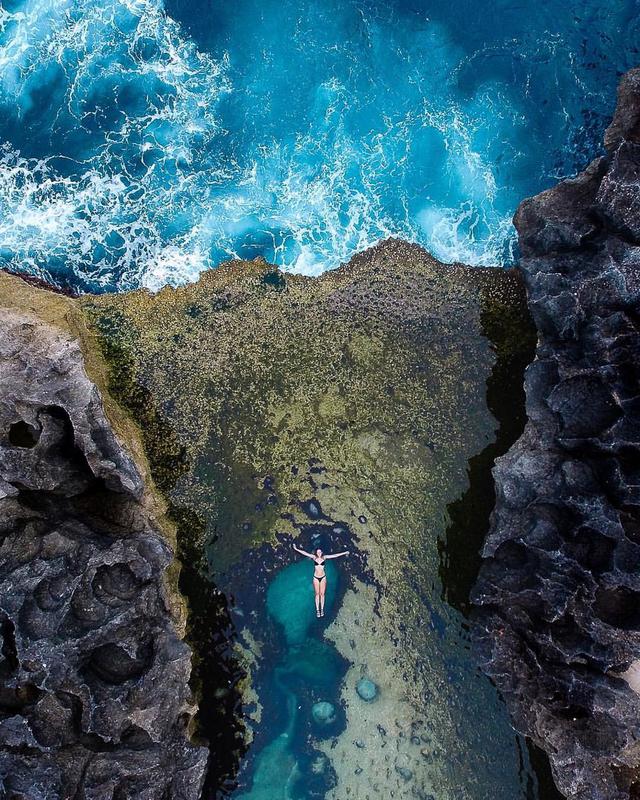
A few hundred metres west, Angel's Billabong is a long channel in a rock shelf at the base of the cliff, open to the sea at one end. Billabong is the Australian word for a waterhole, and on a calm day near low tide the pool is clear enough to see every stone on its floor. That stillness fools people. Indian Ocean swell rolls straight over the outer lip, and large sets can arrive after ten minutes of apparent calm.
That surprise wave explains most of the fatalities. The list runs from a young Australian bride lost in June 2016, through a New Zealander who drowned in March 2017 trying to save a German woman knocked in, to a Chinese selfie-taker in July 2018. On 16 October 2024 an Indian travel agent, 59, was washed away while his wife photographed him; he was found off Nusa Dua the following day. Broken Beach's hazard is height instead: one Indonesian visitor lived through a fall in November 2022, while an Indian man slipped to his death in March 2023. All swimming was banned here in January 2023.
Access has improved. Tarmac now runs nearly all the way along what used to be Penida's worst approach road, ending at a car park with food stalls and toilets. From 1 September 2026 the regency's One Gate One Destination scheme has treated the two as separate ticketed sites at IDR 25,000 per adult each, paid without cash, on top of the arrival fee for foreigners. Tour cars roll in from late morning, and from about 11 am to 3 pm the rim path becomes a queue for identical photos. Go early or late, near low tide, and keep well back from the edges; with no stairway and an almost flat loop, it is the least strenuous of Penida's great views.
- Opening hours
- No published hours; ticket posts are staffed in daylight
- Ticket
- IDR 25,000 per adult and IDR 15,000 per child at each of the two sites
- Time needed
- About 1 hour for both; 2 hours if you hike in from Crystal Bay
- Best time
- Early morning or late afternoon, at low water with little swell
- Dress code
- No dress code; grippy shoes, a hat and water
- Location
- South-west headland in Bunga Mekar, a 20–30 minute drive from Kelingking
Banjar Sumpang, Bunga Mekar, Nusa Penida, Klungkung Regency, Bali
Open in Google Maps ↗Read it on the Blog →What to see
What to see at Broken Beach and Angel's Billabong
The rim of Broken Beach
A path of concrete and bare rock circles the top of the cove, and a loop that includes Angel's Billabong is only about 1 km on near-level ground. From the inland side you look straight through the arch to open sea; from the flanks you watch swell squeeze through and fan out across the cove. No stairway or boat landing exists, so the sand stays off limits. Parts of the edge are unfenced and the rock can crumble.
Mantas, turtles and rays below
Manta Bay is just along the coast, and its morning snorkel boats are close enough that in 2017 one of their guests hauled a woman from the sea after she was washed off the billabong rocks. Look down from the cliff on a sunny, glassy day and you may see the black diamond shapes of mantas at the surface; turtles and rays turn up more reliably. Polarised glasses cut the glare, and the boats themselves tell you where the action is.
Angel's Billabong when the tide is out
When the tide is out and the swell is small, the channel goes still and transparent, its weedy floor visible from the clifftop. That is the version in the old pictures of swimmers lying in the water. These days signs and a knee-high barrier block the way down, and the safe place to watch is the higher rock on the landward side, well away from the outer lip where the waves break.
Angel's Billabong when the tide is in
At high water, or whenever a big swell is running, the same spot turns into churning white water. Waves spill over the outer rim, flood the pool and pour back out, throwing spray onto the rocks where people stand for photos. It is spectacular from a safe distance and explains exactly why the pool has drowned people who thought it calm. Stay on high ground, watch several sets first and never turn your back to the sea.
Photos and drones
For the classic composition, stand on the inland side of the rim and shoot through the arch, ideally at first light or in the last hours of sun. Drones come out constantly and crash often, mostly by pilots who try to thread the arch and clip the rock. Launch well back from the path and never fly above people. On foot, check where you are standing before every photo; the 2023 fatal fall happened while a visitor was posing on the edge.
Hiking in from Crystal Bay
You can also arrive on foot. From the southern (left-hand, facing the sea) end of Crystal Bay, stairs cross a first rise to Pandan Beach; a harder second climb follows, then woodland past a smaller cove before the ground eases towards the arch. It is a little over 3 km, but the climbs stretch it to about two hours. Book a car for the return, as the road between the two is 18 km.
Seasons
Best time to visit Broken Beach and Angel's Billabong
Arrive before about 10 am or after 3 pm. Tour cars from the morning boats reach the west coast from late morning, and the rim path and pool lookout are busiest between roughly 11 am and 3 pm. Early starts bring soft light and an emptier car park. Late afternoon is quieter and warmer in tone, but leave time for the drive back and for the last sailings to Sanur around 5 pm, and remember the roads are slow in the dark.
Tide and swell decide how Angel's Billabong looks. Near low tide the pool is at its clearest and calmest; at high tide waves surge over its rim. Tide tables for Toyapakeh or Lembongan are the ones to consult, bearing in mind that the lowest tides fall around full and new moon. Swell counts just as much. The biggest swells hit Bali's southern coasts in the dry months, peaking from June to August, and when one is running the rock shelf is unsafe at any tide. Pick low tide and small swell, and stay out of the water regardless.
Overall the dry season, April to October, works best: roads are dry and the water is at its clearest for manta-spotting from the clifftop, although mantas are present all year. Between November and March the roads get slippery but crowds thin outside the Christmas period. No boats run on Nyepi, 8 March 2027, or during Nyepi Segara, the 24-hour sea closure each September or October, so you cannot come over from Bali on those days.
Getting there
How to get to Broken Beach and Angel's Billabong
Banjar Nyuh or Toyapakeh harbour40–60 minutes
About 17–19 km by car or scooter, climbing south from Toyapakeh into the hills before turning west through Bunga Mekar. Drivers wait at both landings; a west-coast day with a car and driver runs about IDR 700,000–1,000,000.
Kelingking Beach20–30 minutes
Roughly 7 km on village roads to the Sumpang headland. Almost every west-side tour links the two, normally Kelingking first.
Crystal Bay40 minutes by car; about 2 hours on foot
There is no coastal road, so the drive is about 18 km. The hilly footpath via Pandan Beach is a little over 3 km.
Sanur Harbour1.5–2 hours, plus check-in
A 30–45 minute crossing to Banjar Nyuh, about IDR 170,000–250,000 one way, then the drive. Arrive 60–90 minutes before sailing; first departures are around 6:30 am.
Sampalan (Kusamba boats)About 1 hour
Some 22 km by road from the north-east harbour. The Kusamba crossing takes 20–30 minutes, a good option if you are coming from east Bali.
Nusa Lembongan1–1.5 hours
A 10–15 minute local boat to Toyapakeh, about IDR 60,000 each way, then the drive with a driver waiting on the beach.
Ngurah Rai airport (DPS)3–4.5 hours
Drive to Sanur Harbour (30–60 minutes), check in, take the 30–45 minute boat, then drive across. After a mid-afternoon landing, stay in Sanur first.
| From | Time | How |
|---|---|---|
| Banjar Nyuh or Toyapakeh harbour | 40–60 minutes | About 17–19 km by car or scooter, climbing south from Toyapakeh into the hills before turning west through Bunga Mekar. Drivers wait at both landings; a west-coast day with a car and driver runs about IDR 700,000–1,000,000. |
| Kelingking Beach | 20–30 minutes | Roughly 7 km on village roads to the Sumpang headland. Almost every west-side tour links the two, normally Kelingking first. |
| Crystal Bay | 40 minutes by car; about 2 hours on foot | There is no coastal road, so the drive is about 18 km. The hilly footpath via Pandan Beach is a little over 3 km. |
| Sanur Harbour | 1.5–2 hours, plus check-in | A 30–45 minute crossing to Banjar Nyuh, about IDR 170,000–250,000 one way, then the drive. Arrive 60–90 minutes before sailing; first departures are around 6:30 am. |
| Sampalan (Kusamba boats) | About 1 hour | Some 22 km by road from the north-east harbour. The Kusamba crossing takes 20–30 minutes, a good option if you are coming from east Bali. |
| Nusa Lembongan | 1–1.5 hours | A 10–15 minute local boat to Toyapakeh, about IDR 60,000 each way, then the drive with a driver waiting on the beach. |
| Ngurah Rai airport (DPS) | 3–4.5 hours | Drive to Sanur Harbour (30–60 minutes), check in, take the 30–45 minute boat, then drive across. After a mid-afternoon landing, stay in Sanur first. |
Know before you go
Tips for your visit
- 01Do not swim in Angel's Billabong or climb down to it. The ban dates from January 2023, and most of the deaths began with people standing by the water for a picture.
- 02Keep several metres from the outer lip of the pool and from the Broken Beach rim, and never step backwards while posing.
- 03Watch the sea for a few minutes before choosing a spot; big sets come between long quiet spells.
- 04Budget IDR 25,000 per adult for each site, plus the arrival fee if you are a foreign visitor, and ask whether your tour has already paid.
- 05Tickets are cashless, by card or QRIS, so bring a card or a phone that can pay, plus small notes for parking and warungs.
- 06Scooter parking is about IDR 5,000; cars have been charged around IDR 10,000.
- 07Wear grippy shoes, because spray keeps the broken rock by the pool slick.
- 08There is no shade on the rim and nothing to buy beyond the car park, so carry water, a hat and sunscreen.
- 09Keep hold of children on the rim path, where some stretches have no fence.
- 10Do not fly a drone through the arch; plenty end up on the rocks.
- 11Ignore map shortcuts from Crystal Bay on a scooter. There is no reliable direct route; use the longer road inland.
- 12Hikers coming from Crystal Bay should leave at dawn with 2 litres of water each, never alone and never in the rain.
FAQ
Broken Beach and Angel's Billabong questions, answered
Is swimming allowed in Angel's Billabong?
+
No. A January 2023 circular from the regent of Klungkung on visitor safety banned swimming at Angel's Billabong, Kelingking and Diamond Beach, and it remains in force in 2026. Older pictures of people bobbing in the pool at low water are misleading: surges can top the rim at any moment, and several visitors have been dragged out to sea. Enjoy it from the rocks above.
How risky is Angel's Billabong?
+
Near the water, extremely. Swell overtops the seaward edge with almost no warning, and four visitors, from Australia (2016), New Zealand (2017), China (2018) and India (October 2024), have died after standing too close. Signs and a low barrier now guard the way down. Watching from the raised rock further inland carries no real risk.
What are the entry fees for Broken Beach?
+
Adults pay IDR 25,000 per site, children IDR 15,000. Since 1 September 2026 Broken Beach and Angel's Billabong count as two separate attractions, so an adult pays IDR 50,000 for both. Payment is cashless. Foreign visitors also pay Penida's IDR 25,000 arrival fee, and parking is extra. Before the scheme began, only a small parking or village charge applied.
What does the name Pasih Uug mean?
+
It is what Balinese speakers call the site. Pasih means the sea or shore, and uug means broken or collapsed, a fair description of a cove where the sea cut through the cliff and left an arch, as if a chunk of headland had fallen away. You may also see it written Pasih Uwug on maps.
Is there a way down to the sand at Broken Beach?
+
No. Neither a stairway nor a trail leads into the cove, and no boat lands on its sand, so you experience Broken Beach entirely from the clifftop loop. Do not attempt to climb down: the walls are about 40 m high and people have been seriously injured or killed falling from the edge.
How far apart are Broken Beach and Kelingking?
+
About 7 km by road, which takes 20 to 30 minutes. Nearly every west-coast tour pairs them, usually Kelingking first thing, then Broken Beach and Angel's Billabong, then lunch and a snorkel at Crystal Bay, roughly 18 km and 40 minutes further on.
When is Angel's Billabong at its best?
+
When the tide is low and the swell gentle, and preferably outside the 11 am to 3 pm rush. Use a Toyapakeh or Lembongan tide chart to plan. At high tide, or during a big dry-season swell, waves flood over the rim; the spectacle is best enjoyed from a long way back.
Will I spot manta rays from the cliffs?
+
Sometimes. Manta Bay is close by, and on still, bright days the cliff gives an occasional glimpse of a manta, with turtles and rays far more common. If an encounter really matters, join one of the morning snorkel boats that leave Toyapakeh, Crystal Bay and Lembongan rather than counting on the view.
Can I hike from Crystal Bay to Broken Beach?
+
Yes. The coast path is only a little over 3 km but takes about two hours, with a climb to Pandan Beach, a stiffer second hill and a forest section before the final easy stretch. Wear proper shoes, carry plenty of water and arrange a lift back, as the road between them is 18 km.
How much time should I allow here?
+
Plan on an hour. The combined circuit is roughly 1 km, yet the views keep you stopping, and it is worth lingering to see a few waves break across the pool. Add 20 to 30 minutes to scan for mantas from the cliff or to eat at the car-park warungs.
Is Broken Beach worth including?
+
Yes. The arch and cove are among the most striking pieces of coast in the Bali region, they sit just 7 km from Kelingking, and unlike Kelingking they involve no steep climb. You cannot swim or reach the sand, midday is crowded and you now buy two tickets, but early or late, with swell surging through the arch, it is the easiest big view on Penida.
Nearby
Pair it with
Kelingking Beach
The T-Rex headland and its steep path to the sand, Penida's best-known view; 7 km, 20–30 minutes by car.
Crystal Bay
The west coast's easiest beach, with warungs, snorkelling inside the moored boats and sunset; 40 minutes by car or about 2 hours on foot.
Tembeling forest and pools
A forest track to a small temple and spring-fed pools where swimming in the natural pool is permitted; 35–45 minutes by car.
Banah Cliff Point
A pair of free clifftop lookouts further along the south-west coast, one facing a pierced sea stack; 35–45 minutes by car.
Diamond Beach
Limestone stacks and a cliff stairway on the east coast, 1 to 1.5 hours away; best kept for a second morning.
More in Nusa Penida