
Jimbaran · Culture
Garuda Wisnu Kencana (GWK) Cultural Park, Jimbaran
A 121-metre Vishnu on Garuda, carved into a limestone hill above Jimbaran, with dances by day and a Barong show at dusk.
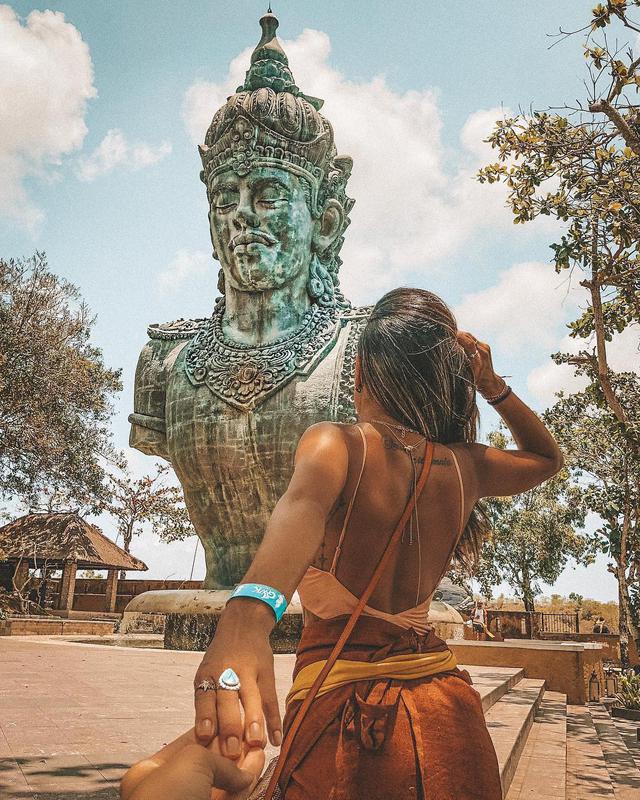
By the Baligasm editors · Updated 29 October 2026 · Photo by @thaylise_ferreira
Overview
Garuda Wisnu Kencana (GWK) Cultural Park: before you go
Garuda Wisnu Kencana is a 60-hectare cultural park in Ungasan, roughly 6 km uphill from Jimbaran Bay and 30–40 minutes from the airport. Its centrepiece is Indonesia's tallest statue, a 121-metre Vishnu riding Garuda. Regular entry is IDR 150,000 and covers the daytime dances; a visit takes about two hours, or three to four with the statue tour and the evening show. Good for families and monument fans; less so for anyone who wilts in the heat.
The Balinese sculptor I Nyoman Nuarta drew up the design in 1990, and ground was broken in 1997. Within months the Asian financial crisis froze the project, and it stood half-built for 16 years until the developer Alam Sutera took over in 2013. The final modules were hoisted in July 2018, and President Joko Widodo opened the monument on 22 September that year. Of its 121 metres, 46 are pedestal; the 75-metre figure is copper and brass over a steel frame, with wings spanning 64 metres. GWK describes it as the fourth-tallest statue on earth. Separate plazas hold a 23-metre bust of Vishnu and an 18-metre head of Garuda.
The scene comes from the Mahabharata. Winata, Garuda's mother, has been enslaved by her sister Kadru, mother of the serpents, and the only price of her freedom is tirta amerta, the elixir of immortality. Garuda battles through the armies of the gods to seize it, and Vishnu, touched by his loyalty, lets him keep it on one condition: that Garuda carries him from then on. So the hill shows the preserver god on the bird of devotion and sacrifice. Kencana is Balinese for gold, hence the gold glass mosaic, imported from Italy, that covers Vishnu's crown.
Because the park was quarried out of a limestone hill, much of a visit is spent walking between sheer cut walls and across open plazas, including the 4,000 m² Lotus Pond, where President Widodo hosted G20 leaders at a cultural dinner in November 2022. Short dances run on the amphitheatre stage through the day, the BarAong show starts at 6 pm from Wednesday to Saturday, and a guided tour climbs inside the statue to its 9th and 23rd floors.
Be clear about what this is: a privately run cultural park, not a temple, though a small spring shrine sits beside the Vishnu bust. It has also become pricier. Standard entry now costs IDR 150,000, and the statue package IDR 400,000, against IDR 300,000 in 2024. Walks are long, shade is thin, and by noon the pale stone throws the heat back at you. Arrive after 3 pm with the right ticket for your plans, and it is one of the simplest half-days on the Bukit.
- Opening hours
- Daily from about 8–9 am to around 9 pm; confirm the closing time at the gate
- Ticket
- IDR 150,000; IDR 400,000 with the Top of the Statue tour; under 100 cm free
- Time needed
- Two hours; allow three to four for the tour and the evening show
- Best time
- From 3 pm, ideally Wednesday to Saturday for the 6 pm BarAong
- Dress code
- Light clothing, a hat and walking shoes; a sarong for the shrine
- Location
- Ungasan, about 6 km above Jimbaran Bay (15–25 minutes)
GWK Cultural Park, Uluwatu Road, Ungasan, Kuta Selatan, Badung, Bali 80364
Open in Google Maps ↗Read it on the Blog →What to see
What to see at Garuda Wisnu Kencana (GWK) Cultural Park
The statue and the Titian Garuda bridge
The monument crowns the highest ground in the park, and its detail only shows as you approach: a skin of copper hammered by hand into triangular plates, a green patina hurried along with acid, and Garuda's head turned to the left. Nuarta's reasoning is that Garuda has to face evil as well as good for life to stay in balance. A 239-metre footbridge, Titian Garuda, joins the statue to Plaza Garuda, and GWK rates it the best place to watch the sunset.
Top of the Statue tour
Sold only as part of the IDR 400,000 Ultimate package, which includes park entry, this tour takes a lift into the statue itself. On the 9th floor are dioramas, original sketches and objects from the decades of construction, along with a short animated film. A glass lift then rises to the 23rd floor, about 90 metres up, where a glass floor and windows look over the runway, Jimbaran, Kuta and Nusa Dua. Allow about 45 minutes, and book your slot at the Plaza Bhagawan information desk on arrival.
Daytime dances in the amphitheatre
Fifteen short performances fill the programme between 10 am and 5 pm, most of them on the open-air amphitheatre stage, which seats roughly 800. Look out for Oleg Tamulilingan, a courtship duet of two bumblebees, at 11 am and 3 pm; the Barong and Bojog, in which monkey-masked dancers tease the Barong, at 3 pm; a 4 pm procession of two trance dances, Sanghyang Jaran and Sanghyang Dedari; and Joged Bumbung at 5 pm, when performers pull audience members up to dance.
BarAong at 6 pm
GWK's own modern Barong production uses giant masks, stage lighting and a soundtrack, and runs from 6 to 6:30 pm in the amphitheatre, Wednesday to Saturday only. Disaster strikes the kingdom of Prince Bara, who can save it only by bringing together three Barongs: Sang Mong the white tiger, Sang Bawi the black boar and Sang Banas the red lion. It is lively, interactive and pitched at families rather than a temple ritual. Show-only tickets are IDR 125,000; with day entry, IDR 200,000.
The Lotus Pond
This is the largest open space in the park: more than 4,000 m² between towering limestone pillars, with room for 7,000 people, used for concerts, festivals and state banquets. GWK's programme has also listed a daily 6 pm Kecak here, a version built around Garuda's quest rather than the Ramayana, with towering ogoh-ogoh figures. The ticket pages for October 2026 make no mention of it, so ask at the gate whether it is running.
Plaza Wisnu and Parahyangan Somaka Giri
The highest point of the park is Plaza Wisnu, home to the 23-metre copper bust of Vishnu. Next to it, up steps lined with white and yellow umbrellas, Parahyangan Somaka Giri is a shrine built around a spring that local people say has never run dry. A jro mangku, or temple priest, can lead a brief prayer, sprinkle holy water and tie on a tridatu bracelet of red, white and black thread; GWK says the ticket covers this. Wear a sarong here.
Plaza Kura-Kura and Jendela Bali
Naga-lined stairs drop to Plaza Kura-Kura, a little garden built round a turtle pond, a statue of Dewi Laksmi, goddess of prosperity and Vishnu's consort, and four reliefs of his avatars, among them Matsya the fish and Varaha the boar. Visitors toss coins in for luck, and short canang-making sessions run here. At the park entrance, the Jendela Bali restaurant looks north over Jimbaran, the airport and Denpasar; you can eat there without a park ticket, and dusk is the moment to go.
Seasons
Best time to visit Garuda Wisnu Kencana (GWK) Cultural Park
Aim to arrive at 3 or 4 pm. The heat is easing by then, the Barong and Bojog dance is on at 3 pm, the trance-dance procession at 4 pm and Joged Bumbung at 5 pm, and the day ends with BarAong at 6 pm and the sun setting over the Bukit, between roughly 6:05 and 6:45 pm depending on the month. GWK points out that mornings are quieter, but the plazas offer little shade and are baking by 11 am. For the statue tour, a clear sky matters more than the time.
Think about the day of the week as well. BarAong runs from Wednesday to Saturday only, and the combined entry-and-show ticket cannot be bought for other days. Indonesian school holidays, the Lebaran week and the stretch from Christmas to New Year bring domestic crowds and coaches. On 31 December regular tickets are withdrawn because of the Bali Countdown party, and in 2026 the Ogoh-ogoh festival on 22 March admitted festival ticket holders only. On Nyepi, 8 March 2027, all of Bali closes.
Views from floor 23 are sharpest in the dry season, April to October. In the wet months, November to March, storms often break in the afternoon and soak the outdoor dances, and GWK tells visitors to pack for both sunshine and showers. When it pours, head inside the statue or up to Jendela Bali.
Getting there
How to get to Garuda Wisnu Kencana (GWK) Cultural Park
Jimbaran Bay15–25 minutes, more between 4 and 7 pm
Roughly 5–6 km uphill on Uluwatu Road by car, ride-hailing car or scooter. From late afternoon the junction in Jimbaran backs up with cars bound for Uluwatu, so start out no later than 3:30 pm.
Ngurah Rai Airport (DPS)30–40 minutes
Roughly 11–13 km by car, either through Jimbaran or along the Bali Mandara toll road towards Nusa Dua.
Uluwatu (Pecatu, Bingin, the temple)20–40 minutes
About 11–13 km along Uluwatu Road. If you also want the temple's 6 pm Kecak, see GWK first and leave by early afternoon.
Nusa Dua20–30 minutes
Around 10 km by car or scooter on the bypass, then up through Ungasan.
Kuta or Seminyak35–50 minutes from Kuta; 50–75 from Seminyak
Kuta is roughly 14 km away and Seminyak 19 km, using the bypass or the toll road; allow an extra 30 minutes or more from 4 to 7 pm.
Canggu or Ubud1–1.5 hours from Canggu; 1.5–2.5 from Ubud
Roughly 28 km from Canggu and 44 km from Ubud with a driver. From Ubud, treat it as a stop en route to a southern hotel, not a there-and-back outing.
| From | Time | How |
|---|---|---|
| Jimbaran Bay | 15–25 minutes, more between 4 and 7 pm | Roughly 5–6 km uphill on Uluwatu Road by car, ride-hailing car or scooter. From late afternoon the junction in Jimbaran backs up with cars bound for Uluwatu, so start out no later than 3:30 pm. |
| Ngurah Rai Airport (DPS) | 30–40 minutes | Roughly 11–13 km by car, either through Jimbaran or along the Bali Mandara toll road towards Nusa Dua. |
| Uluwatu (Pecatu, Bingin, the temple) | 20–40 minutes | About 11–13 km along Uluwatu Road. If you also want the temple's 6 pm Kecak, see GWK first and leave by early afternoon. |
| Nusa Dua | 20–30 minutes | Around 10 km by car or scooter on the bypass, then up through Ungasan. |
| Kuta or Seminyak | 35–50 minutes from Kuta; 50–75 from Seminyak | Kuta is roughly 14 km away and Seminyak 19 km, using the bypass or the toll road; allow an extra 30 minutes or more from 4 to 7 pm. |
| Canggu or Ubud | 1–1.5 hours from Canggu; 1.5–2.5 from Ubud | Roughly 28 km from Canggu and 44 km from Ubud with a driver. From Ubud, treat it as a stop en route to a southern hotel, not a there-and-back outing. |
Know before you go
Tips for your visit
- 01Buy tickets on ticket.gwkbali.com and pick your date before anything else: BarAong options only appear for Wednesday to Saturday.
- 02At the gate, the ticket counter is in Plaza Bhagawan, reached from the Parkir A car park on a free shuttle that also stops at Jendela Bali.
- 03Payment online is by card, GoPay, OVO or QRIS, and the e-ticket arrives by email.
- 04Children shorter than 100 cm go in free, so toddlers need no ticket.
- 05It is about 1 km on foot from Plaza Bhagawan to the statue, with slopes and stairs, steepest up to Plaza Wisnu. A buggy seat is IDR 40,000 a person for one ride from the gate plaza up to the statue, continuing to Festival Park, and comes only with an entry ticket.
- 06Bring a hat, sunscreen, an umbrella and water; the plazas are exposed and the stone reflects the heat.
- 07Ask for your Top of the Statue slot at the Plaza Bhagawan information desk as soon as you arrive.
- 08On busy evenings, take your amphitheatre seat 20 to 30 minutes before BarAong; there are about 800 places.
- 09Carry a sarong if you want the blessing at Parahyangan Somaka Giri.
- 10Entry is valid for the whole day; if you pop out for lunch, have your hand stamped at the exit so you can come back for the show.
- 11Look for promo codes on the ticket page; one cut regular entry by 20% for visits between 19 and 25 October 2026.
- 12After the 6 pm show the amphitheatre empties at once and rides are slow to find, so keep your driver waiting or fix a pickup time. On a scooter, ride Uluwatu Road back to Jimbaran carefully after dark.
FAQ
Garuda Wisnu Kencana (GWK) Cultural Park questions, answered
How much does a GWK ticket cost?
+
Standard entry is IDR 150,000. The Ultimate package, which adds the Top of the Statue tour, is IDR 400,000. From Wednesday to Saturday there is also a combined entry and BarAong ticket at IDR 200,000, or a show-only ticket at IDR 125,000 that includes the park after 6 pm. The buggy is IDR 40,000 per person, and children under 100 cm enter free.
When is GWK open?
+
Every day, though the ticket site does not publish gate times. GWK's own recent material gives an opening of 8 or 9 am and a close at about 9 pm, and some older listings give 8 am to 10 pm. Dances start at 10 am, and the gates stay open beyond the BarAong show on its four nights. Ask staff at the entrance when they shut.
Is GWK worth visiting?
+
For lovers of big monuments, Balinese dance or engineering, and for families, yes: a giant statue plus a Barong show fills a relaxed afternoon only 15 to 25 minutes from Jimbaran. Those hoping for an ancient temple, or who suffer in the heat, may be disappointed. Entry also costs more than Uluwatu Temple's, and a large share of the visit means walking across exposed stone.
Should I pay extra for the Top of the Statue tour?
+
Most first-time visitors find it worthwhile. For IDR 250,000 more than standard entry, a guide takes you up for roughly 45 minutes, first to the museum on floor 9, then to floor 23, some 90 metres high, where you stand on glass and look across the runway and the southern coastline. Save your money on a hazy day or if heights unsettle you.
How tall is the statue?
+
The whole monument is 121 metres, of which 46 are pedestal, so Vishnu on Garuda measures 75 metres on its own. The wings stretch 64 metres, and the structure weighs around 4,000 tonnes. No statue in Indonesia is taller; it also tops the Statue of Liberty including its base, and GWK ranks it fourth-tallest in the world.
Who made GWK, and how long did it take?
+
I Nyoman Nuarta, a Balinese sculptor, designed it in 1990, and building started in 1997. The Asian financial crisis that year stopped the work for 16 years, until Alam Sutera Realty took the project on in 2013. The last of more than 700 modules was lifted into place in July 2018, and President Joko Widodo opened the statue on 22 September 2018.
What performances can I see, and when?
+
Around 15 short daytime dances run from 10 am to 5 pm, among them the Barong and Bojog at 3 pm and Joged Bumbung at 5 pm, all included in the standard ticket. BarAong plays from 6 to 6:30 pm on Wednesday to Saturday and needs its own ticket. A daily 6 pm Kecak at the Lotus Pond has also appeared on GWK's schedule; ask at the gate.
How much time should I allow?
+
Two hours covers the walk to the statue, Plaza Wisnu and a dance or two, which is what GWK suggests for most visitors. Adding the statue tour (about 45 minutes) and the evening BarAong stretches it to three or four hours, longer still with dinner at Jendela Bali. The drive from Jimbaran adds 15 to 25 minutes each way.
Uluwatu Kecak or a GWK show: which should I choose?
+
Go to Uluwatu for the traditional Ramayana Kecak on a cliff at sunset, at IDR 150,000 plus temple entry, with large crowds and a slow drive home. Choose GWK for BarAong, a modern family show far closer to Jimbaran and the airport. Both begin at 6 pm, so one evening cannot hold both.
Is there transport inside the park?
+
Yes. A free shuttle links the Parkir A car park with Plaza Bhagawan, where the ticket gate is, and with the Jendela Bali restaurant. Inside, a buggy (IDR 40,000 per person per trip, entry ticket required) carries you from the gate up to the statue and then Festival Park. Otherwise it is roughly 1 km on foot with slopes.
Can I buy tickets on the day?
+
Yes, at the counter in Plaza Bhagawan. Booking ahead on ticket.gwkbali.com avoids the queue and, GWK says, is safer for BarAong at weekends and on holidays. Choose your date first, because show tickets only appear for Wednesday to Saturday, and certain event dates, 31 December among them, are closed to regular entry.
Nearby
Pair it with
Seafood dinner on Jimbaran Bay
Grilled fish at a table on the sand at sunset, 15–25 minutes downhill; the classic way to finish an afternoon at GWK.
Melasti Beach
Calm, swimmable sea at the foot of a road sliced through white limestone, about 6 km away; ideal for a morning swim before GWK.
Pandawa Beach
Statues of the five Pandawa brothers set into the cliff road above a long, calm beach; 15–25 minutes by car.
Uluwatu Temple
Bali's cliff-top sea temple, whose sunset Kecak clashes with BarAong, so choose one per evening; 25–40 minutes by car.
Padang Padang Beach
A small cove reached through a cleft in the rock, known for its reef break; 20–35 minutes by car.